Oakland County Children's Village seen on Thursday, July 9, 2015 in Pontiac, MI.
Nine staffers and residents have tested positive for the coronavirus at Oakland County Children's Village and 17 other employees are self-isolating at home for 14 days.
County health officials are working to mitigate the spread of COVID-19 at the juvenile detention facility after an employee tested positive Sept. 3, according to a statement from the county.
Since then, four more staff members and four residents have tested positive. All were close contacts of each other and were connected to one building. They are in isolation, the county stated.
The county health division has not determined the source of the original exposure.
Children's Village, located in Pontiac, offers detention, residential treatment and shelter care services to children and youth who come under the jurisdiction of the court and are deemed to be temporarily in need of out-of-home care, custody and treatment.
It has seven buildings, but only six are being used right now because the population is low, said Bill Mullan, spokesman for County Executive Dave Coulter.
Mullan said the outbreak occurred in residential treatment. He said three employees and two residents had symptoms.
There are 73 residents and 188 full-time employees at Children's Villages, the county stated in its release.
The health division conducted a contact investigation that required 17 additional employees to self-isolate.
It also tested all Children's Village employees and residents for the virus and will continue to do so until all results are negative, according to the county.
Nearby, the Oakland County Jail, the lockup for adults, reported no cases of the coronavirus on Wednesday, Undersheriff Mike McCabe said.
Jail officials were sued earlier this year in federal court related to inmate care amid the COVID-19 pandemic, but the sheriff's office won an appeal in July.
The FBI has arrested multiple Toledo city council members accused of taking cash in exchange for votes during what is described in court records as a years-long, sweeping bribery scandal involving some of the city’s highest elected officials.
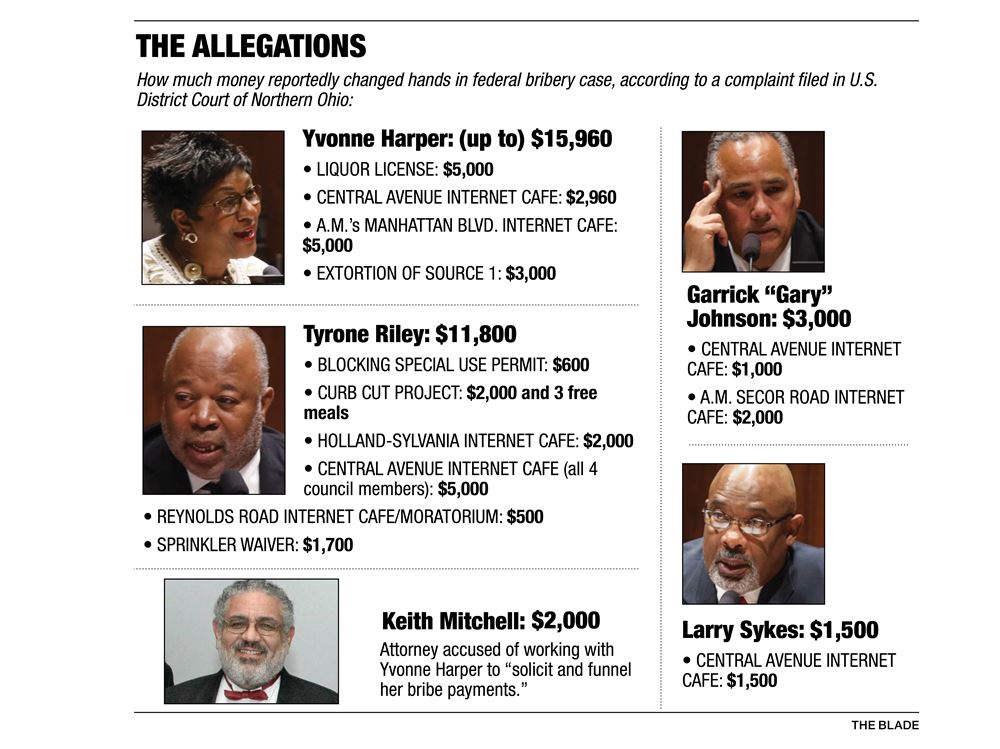
City council members Tyrone Riley, Yvonne Harper, Larry Sykes, and Gary Johnson are all charged in federal court with accepting bribe payments for official acts and extortion, according to criminal complaints filed Tuesday. Keith Mitchell, an attorney who is accused of funneling bribes to Ms. Harper, also faces bribery and extortion charges. Ms. Harper is charged as well with interstate communications with intent to extort.
There was no answer at the Grand Avenue home listed for Keith Mitchell, an attorney, in Toledo on Tuesday. The FBI has taken multiple city councilmen in custody in a bribery case.
Attorney facing charges has history of involvement in council issues
FBI Special Agent Eric Smith in a Tuesday afternoon news conference said the councilmen were arrested without incident earlier in the day, while authorities are “actively seeking the whereabouts of Keith Mitchell.”
He said the councilmen committed a “fundamental breach” of the oath they took upon taking office, and violated the public’s trust for their own personal gain. The maximum prison sentence for bribery is 10 years, while the maximum for the extortion charge is 20.
Ms. Harper could face an additional two years in prison for the additional charge.
Details in the complaint suggest up to $34,260 changed hands between business owners, the councilmen, and Mr. Mitchell during the course of the investigation.
“The residents of Toledo should know, as should every other resident of the Northern District of Ohio, that where there are allegations of public corruption and kickbacks, we and our federal partners will be there every time,” U.S. Attorney Justin Herdman said in a statement.
The four council members appeared before Magistrate Judge James Knepp II by video conference in U.S. District Court in Toledo on Tuesday afternoon.
U.S. Assistant Attorney Michael Freeman said the government did not seek detention for any of the defendants. Each councilman was released on a $50,000 unsecured bond, meaning if they fail to appear in court, they owe the government that much money. Additionally, they were barred from out-of-state travel and from having contact with co-defendants, victims, and witnesses.
Toledo bribery scandal rocks Lucas County's long-dominant political party
“I don’t know anything; I don’t know how this came about,” Ms. Harper told The Blade as she left the courthouse Tuesday afternoon.
She would not address the accusations of soliciting bribes, nor would she say if she will step down from her post on council.
Her attorney, Jon Richardson, could not be reached for comment. Ronnie Wingate, an attorney representing Mr. Sykes, declined to comment.
Both Mr. Riley, himself an attorney, and Mr. Johnson did not yet have legal representation but are expected to hire lawyers.
Toledo Mayor Wade Kapszukiewicz said in a statement that he was “shocked and heartbroken by today’s arrests.”
“This is a terrible day for Toledo — and for everyone who believes in the good that can be accomplished through public service,” he said.
Matt Cherry, president of city council and a Democrat like his accused colleagues, said he and other councilmen are cooperating with the investigation.
“Corruption of any kind cannot be tolerated and has no place in the government of Toledo and Ohio,” he said in a statement.
Court records suggest that one council member — Mr. Riley — has been soliciting bribes since at least 2013. It was Mr. Riley’s actions that also seemed to initially draw the attention of the FBI.
The criminal probe appears to have started on March 5, 2018, when a federal agent interviewed an unnamed source who owns several commercial properties, primarily gas stations and convenience stores, within the city. That person, who was arrested in 2018 for being in the United States illegally, reported previously providing things of value to Mr. Riley in exchange for his vote on matters before council.
Investigators noted that they believe the source married a U.S. citizen in 2000 with the sole intent of obtaining immigration benefits, but was denied lawful permanent resident status based on the fraudulent marriage, which was denied. The source has remained in the United States without lawful immigration status and is still subject to criminal and immigration consequences, according the complaint.
The source in 2013 purchased a gas station and convenience store on Dorr Street. Shortly thereafter, another business wanted to open a competing store nearby, but needed city council to approve a special use permit.
When the source asked Mr. Riley to vote against the permit, the councilman asked for a political donation, according to a criminal complaint.
The source wrote a $300 check to Mr. Riley, the complaint states. Additionally, Mr. Riley asked the source if alcohol could be delivered to the source’s business for Mr. Riley’s upcoming fund-raiser.
"Source 1 opined Riley did so in order to avoid paying the requisite taxes on alcohol by having the alcohol delivered to a liquor license holder. Source 1 agreed to accept the delivery of alcohol," according to the complaint.
Mr. Riley also requested that the source pay the delivery fee of $300. The source agreed, as long as Mr. Riley didn’t cash the $300 check he/she just provided, court records state. Still, Mr. Riley cashed the $300 check, and the councilman did not reimburse the source for the delivery fee, in essence taking $600.
In May, 2018, the source filed paperwork with the city requesting a "curb cut ” — a small ramp built into the curb of a sidewalk — be placed near a Dorr Street gas station in order to increase traffic flow into the business. The business was in Mr. Riley's district and such a request required a special permit that needed approval from city council.
Prior to the vote on May 23, 2018, the source met with Mr. Riley for lunch to discuss the matter. Mr. Riley expressed his support for the project. After the meal, Mr. Riley never attempted to pay for his portion of the approximately $130 restaurant bill, according to court records.
“Mr. Riley then ordered a meal (prime rib and carrot cake) ‘to go,’ knowing source 1 would pay for it,” a complaint states.
During a conversation in the parking lot, Mr. Riley also told the source he wanted $2,000 to be delivered to a family member.
During a second lunch meeting on May 31, 2018, the source provided Mr. Riley with $2,000 and informed Mr. Riley that it was the money, “for his support,” according to court records. A second unnamed person, identified as ‘middleman 1’ in court documents, joined the source and councilman for lunch then added $1,000 for Mr. Riley to accept a total of $3,000.
The middleman was directed to take the $3,000 in lieu of Mr. Riley accepting the funds in a public setting, records show. The middleman then purchased four $500 money orders with the money, forging the source's name as the purchaser with the money orders payable to Mr. Riley.
Over several months, Mr. Riley deposited $1,500 worth of money orders in his “Riley for Council,” account and then deposited the other $500 money order in his “Smith Park Community Coalition” account. Mr. Riley hosts an annual family festival at Smith Park in his district, which includes a bicycle giveaway for kids.
On Dec. 10, 2018, an FBI agent approached the middleman, who admitted to paying bribes to Mr. Riley and acting as a conduit to funnel bribes to the councilman, according to the complaint. That person then agreed to cooperate with the FBI investigation, becoming identified as source 2 in court documents.
Source 2 does not have a criminal history, however his/her actions prior to cooperating are subject to criminal penalties. Internet cafe businesses, which source 2 operated, may be in violation of federal or state gaming laws, records show.
The next day, source 2 spoke to Mr. Riley about the curb cut and indicated the first source was willing to pay more money if necessary.
On Jan. 2, 2019, source 1 — the owner of the Dorr Street gas station — again met for lunch with Mr. Riley to discuss the May, 31, 2018 bribe payment.
The councilman reassured source 1 that he would take care of everything necessary to get the special permit approved, records show. He also asked the source to financially support a re-election event and again left without paying for his meal.
On April 30, Mr. Riley informed source 1 that he garnered enough votes for council to support the curb cut permit, but that he would have to abstain from voting, according to the complaint. He later told the source that his abstention was to make sure that was no “appearance of impropriety.” City council approved the special permit but source 1 was required to install a sprinkler system on the property.
The gas station owner then met with Mr. Riley for lunch on May 9, 2019, thanking the councilman for his assistance. Mr. Riley again left the restaurant without paying for his meal, and added a piece of carrot cake "to go," according to the complaint.
On Tuesday, Mr. Riley told The Blade while standing outside the federal courthouse that he did not accept any bribes, and he needed to review the charges to understand how the allegations came about.
Internet cafe votes
Before ever becoming an FBI informant, the ‘middleman’ from the gas station curb cut exchange had applied for his own rezoning request to open an internet cafe business on Holland-Sylvania Road in April, 2018, according to the complaint. In that matter, too, the source paid Mr. Riley $3,000 for his support, according to court records.
The cafe came up for a vote on Oct. 23, 2018, and an FBI agent present at that council meeting witnessed Mr. Riley give source 2 a "thumbs up," in council chambers.
The next day, the source sent an additional payment of $1,000, which Mr. Riley directed to go to the Smith Park Community Coalition.
Federal investigators contend bank records confirmed the source paid Mr. Riley a total of $2,000.
Internet cafes continued to play a role in the FBI probe as it unfolded.
In October, 2018, source 2 applied for a special use permit to open an internet cafe on Central Avenue, which was within Ms. Harper's district.
The source was not as familiar with Ms. Harper and reached out to a fellow Toledo business owner — unnamed in court records — who received a renewal of a liquor license in April 2016, despite strong opposition from neighboring businesses and Toledo police, court records show.
The fellow business owner told source 2 that he paid approximately $5,000 in bribes through a local attorney — Mr. Mitchell — which was “the only way to ensure her support,” according to court records. The business owner suggested source 2 do the same thing and set up a meeting between them and the councilman.
About two weeks before the permit vote, Ms. Harper called source 2 and said she needed him/her to sponsor two tables at an upcoming event totaling $640, the complaint states. Source 2 on Feb. 12, “provided the requested money orders totaling $640 to Harper’s assistant while inside Council chambers,” according to court records. “Moments later, Harper sat on the Planning Committee and advocated for” the special use permit to go through.
Authorities contend source 2 eventually bribed four city council members for supportive votes: Ms. Harper through Mr. Mitchell, Mr. Johnson, Mr. Riley, and Mr. Sykes. Council unanimously passed the special use permit on Feb. 25, 2020.
Federal authorities point to other special use permit votes regarding internet cafes they contend were influenced by bribes, including two votes related to businesses owned by an acquaintance of source 2.
Ms. Harper, through Mr. Mitchell, is accused of accepting bribes from that acquaintance in exchange for an affirmative vote on July 23, 2019, for a Manhattan Boulevard internet cafe.
That acquaintance in December, 2019, filed another permit request to open an internet cafe, this time on Secor Road, but the Toledo City Plan Commission in February recommended council reject the request.
This time, federal officials allege, it was Mr. Johnson who accepted bribes in exchange for a “yes” vote. Even with the affirmative votes of other councilmen, including Ms. Harper, Mr. Riley, and Mr. Sykes, the permit request failed.
Source 2 reached out to Mr. Johnson to see if there was any way the acquaintance could appeal the decision. Source 2 gave Mr. Johnson $2,000 in cash toward his campaign for Lucas County sheriff, court records show.
The councilman then advised source 2 to call the plan commission staff because “you don’t want it to come through one of us (City Councilpersons), ‘cuz it’s gonna look like a quid-pro-quo,” court records show.
As Mr. Johnson left the federal courthouse Tuesday, he told The Blade he was confused by the whole situation and needed to hire an attorney.
Greg Gilchrist, professor at the University of Toledo’s College of Law, said that, in general, criminal cases involving bribery charges against public officials require evidence that the money or gift was provided in direct exchange for an official act, such as voting a certain way on a particular issue.
That can be difficult to prove, Mr. Gilchrist said, because politics is awash in money and public officials could argue that the funds were received as part of a campaign contribution, or that the person paying out the alleged bribe wasn’t trying to sway a vote but was simply buying goodwill.
“You see this all over politics in more sophisticated ways that never become criminal,” he said.
Both the general public and corporations have the right to spend money, per the Supreme Court, in support of political issues. Lobbying, though, typically isn’t done with an explicit understanding that the money is paying for a direct action from a politician, Mr. Gilchrist said.
The line between legal financial contributions and criminal activity can be blurry, he said.
“I think we have a real problem with the state of the law here,” Mr. Gilchrist said.
He also noted that paying a bribe is illegal as well, but prosecutors often focus bribery investigations on any public officials involved rather than those seeking a favor. That’s because public officials’ misconduct would mean a violation of the public trust, Mr. Gilchrist said, though he advised citizens to withhold judgment until more of the facts are brought to light.
“Right now, all we have is a complaint,” he said.
Tuesday’s events are not the first time Toledo’s elected officials have been charged with accepting bribes.
Former Toledo Councilman Bob McCloskey served about 20 months in federal prison term after pleading no contest in Lucas County Common Pleas Court and guilty in federal court to unrelated bribery convictions in 2006.
The federal conviction stemmed from two FBI stings in which the former Democratic councilman accepted $5,000 from a businessman who wanted assistance from the city on development projects. The conviction in Common Pleas Court stemmed from a 2002 case in which McCloskey was accused of working for the defeat of a rezoning application because the applicants refused to set up a $100,000 prescription drug fund for Pilkington Plc retirees.
McCloskey, of East Toledo, was elected as a district councilman in 1993 and continuously re-elected until 2005 when he was elected to an at-large seat.
In the current case, Mr. Sykes is accused of accepting bribes tied to several votes related to internet cafes, including two owned by source 2 on Reynolds Road.
Source 2, according to the complaint, applied for the permits in September, 2019, and during that same time wanted councilmen to pass a moratorium on additional internet cafes to cut down on competition.
Court records suggest source 2 paid Mr. Sykes $1,000 in exchange for three votes in favor of the cafes and the moratorium legislation. Source 2 paid Mr. Riley $5,500 for those same favors, the complaint states.
Upon his exit from the courthouse, a reporter asked Mr. Sykes if he intends to step down from his elected position:
Do you know why these "gentrification" small businesses are going belly up by getting denied that Precious Payroll Protection Plan?
Well, it is because these people got these properties illegally, like the Detroit Land Bank Authority, through fake ass quiet titles, through fake ass LLCs, mostly in TARP regions with land banks, because they cannot make their multiple mortgage payments, because the banking system is falling internationally like dominoes.
Check out how many are christian businesses shuttering.
They all run those tiny humans trust fund schemes through lots of christian trafficking tiny humans trust funds like Catholic Charities through the Archdiocese of Detroit.
The Will Play For Food Foundation was created specifically to assist and enable communities to End Childhood Hunger, by creating Awareness of hunger issues, help to create and share Solutions to hunger, and to connect recipients, donors, orgs, and businesses to achieve measurable results.
They are associated with St. Jude's Children's Hospital through the
Children's Hospital Miracle Network
&
Feeding America
The name of the DOMESTIC LIMITED LIABILITY COMPANY: BARFLY VENTURES, LLC Entity type: DOMESTIC LIMITED LIABILITY COMPANY Identification Number: 801537162Old ID Number: D3898Q Date of Organization in Michigan: 02/01/2010 Purpose: All Purpose Clause Term: Perpetual The name and address of the Resident Agent: Resident Agent Name:MARK A SELLERS III Street Address:35 OAKES ST SW STE 400 Apt/Suite/Other: City:GRAND RAPIDSState:MIZip Code:49503 Registered Office Mailing address: P.O. Box or Street Address: Apt/Suite/Other: City:State:Zip Code: Act Formed Under: 023-1993 Michigan Limited Liability Company Act
It seems his liens lapsed due to the fact that he was probably busted doing that Corporate Shape Shifter thing, they like to do, all the time, or rather, stealin' the children, land & vote, more intuitively recognized in the legal parlay as gerrymandering.
His credit shot and he got busted, that is why he is filing for bankruptcy.
GRAND RAPIDS, MI — Barfly Ventures, the parent company of HopCat, Stella’s Lounge and Grand Rapids Brewing Co., has filed for bankruptcy to restructure its debt and better position the company for long-term growth.
Mark Sellers, the company’s founder and chairmen of its board, said the company’s debt, which totals more than $30 million, has become untenable because of the coronavirus pandemic, which has shuttered dine-in service for bars and restaurants across the state.
“We were doing okay. We were paying our bills,” Sellers said. “And then COVID hit, and it just sent us over a cliff.”
Despite the filing, a press release issued by the company says it plans to reopen its Michigan restaurants on June 13, and that HopCat locations in Lincoln, Nebraska, and Indianapolis, Indiana, are expected to reopen on June 22. BarFly’s other out-of-state HopCat locations will be opening in phases with dates to be announced soon,” the company said.
“It’s been a rough few months, but we’re excited to welcome our team and local community members back into our restaurants,” Sellers said. “We’re following all CDC guidelines and taking extra precautions to ensure the health and safety of our staff and guests.”
Sellers said the bankruptcy won’t affect day-to-day operations at BarFly’s restaurants.
“From a customer standpoint, it will be no different,” he said. “From a company standpoint, we’ll have more flexibility to grow again in a smart way.”
BarFly is best known for HopCat, the popular restaurant and craft beer bar that started in Grand Rapids in 2008 and expanded rapidly over the past six years.
The first HopCat restaurant outside of Grand Rapids opened in East Lansing in August 2013. The following year, another location opened in Indianapolis, Indiana. Sellers said 14 additional HopCats, including a location in Port St. Lucie, Florida, were opened from August 2014 and 2019.
At its peak, there were 17 HopCats, Sellers said. Today, there are 14, half of which are in Michigan.
Sellers said his company financed the expansion through debt, so it could grow more quickly, rather than relying on “cash flow.” He said the strategy was working fine until some HopCat locations, primarily Chicago, Port St. Lucie and Chicago, started losing money. Those locations have since closed.
“Then when COVID hit, that just put it over the edge,” he said. “We were servicing the debt up until COVID.”
HopCat briefly attempted to offer takeout service after Gov. Gretchen Whitmer on March 16 temporarily suspended dine-in service at Michigan bars and restaurants to reduce spread of the coronavirus. However, the company was losing money in the process, and Sellers decided to close his restaurants to conserve cash and wait-out the pandemic.
He said there was a time in March when he wasn’t sure he was ever going to be able to reopen HopCat. He said he’s hopeful that Hopcat can recover from this, but that the coronavirus has presented a very challenging situation for bars and restaurants.
“My personal net worth is completely decimated by this,” he said. “My stock in BarFly is going to be worthless.”
He added, “This is personally just a very bad situation for me. I just want to see the company that I started survive. That’s really all I care about right now.”
Mark Sellers, owner of Premier Exhibitions, the company that brought Bodies Revealed to the Grand Rapids Public Museum, stands in Hopcat, the brew pub he owns at 25 Ionia Ave. SW.
GRAND RAPIDS — A Chicago hedge fund, a nasty proxy battle, a string of downtown pubs, human remains, the future of the Titanic — mix them together and it’s a recipe for a pulp novel.
As it turns out, they're components of a nonfiction corporate epic whose latest chapter is being written as the Bodies Revealed exhibit opens at the Public Museum of Grand Rapids.
Once upon a time Mark Sellers — who with his wife co-owns the downtown Grand Rapids bars Hopcat, Stella's Lounge and Viceroy — made a risky investment in Premier Exhibitions Inc., which owns the Bodies exhibit that features plasticized human remains.
Today the 42-year-old West Michigan native is chairman of the board of the publicly held company, a title he never wanted.
Three years ago, Atlanta-based Premier was riding high on the success of the sometimes controversial Bodies Revealed exhibit of preserved human bodies and body parts.
The company also had a valuable collection of items from the Titanic shipwreck, along with what it said were exclusive salvage rights to the famed ocean liner.
"It takes a village, then pillages its most precious treasures."
Teach them young to carry on the christian traditions in the residuals of the peculiar institution in modern day human trafficking, for that is the body of a youth, one of those R&D "whoops" tiny humans lab rats.
After nearly a decade, Bodies Revealed has returned to the GRPM. This exhibition features real, whole and partial body specimens that have been preserved through an innovative process, giving visitors the opportunity to view the complexity of their own organs and systems like never before.
At the time, Sellers also was riding high, managing more than $300 million in assets for clients nationwide via his Chicago-based Sellers Capital Management Inc.
Sellers’ strategy for his hedge fund was simple: Bet big on carefully researched, undervalued companies and reap big profits for himself and his investors.
Sellers attended an investment conference and heard an analyst characterize Premier as a favorite stock in 2007.
“At that time the stock was about $11 a share,” he said. “I did my own research, thought it seemed like a good deal and started to take a position in my fund, buying at $10 or $11.”
It was around that time that Sellers, a 1986 East Kentwood High School graduate, and his wife, Michele, had moved back to Grand Rapids — the hometown his younger self had sworn off.
“I never wanted to come back here,” he said. “In fact, I told myself I never would come back here. But then my wife and I looked at houses and real estate prices and the quality of life here, and it’s just a really nice, nice place.”
Trouble revealed
Premier’s stock did well at first, trading above $17 in July 2007.
Then a series of poor quarterly earnings reports started a precipitous decline. Sellers continued buying all the way down — $8 a share, $5 a share, then $2.
“At $1.98 we bought a ton,” he said. “We owned about 16 percent of the company by the end of 2008.”
That's when he decided to take action. Sellers had accumulated enough stock to launch an effort to oust management, whom he said took a promising company to the brink of bankruptcy.
On Nov. 6, 2008, Sellers issued a press release demanding the resignation of Premier’s CEO Arnie Geller, lambasting him for taking $1.2 million in compensation even as the shareholders saw their investment values plunge.
When Geller refused, a proxy battle erupted with Sellers’ firm nominating its own slate of directors in what amounted to a hostile takeover.
By January 2009, Sellers decisively won the battle, was appointed as unpaid, non-executive chairman and fired Geller.
“The company would have almost certainly had to file bankruptcy back in January or February of 2009 if we hadn’t taken control,” said Chris Davino, the CEO and turnaround specialist who took the helm of the company after the proxy fight.
Not long after the takeover, Sellers Capital helped pump another $12 million into the company while working with the new management team to restructure. Among the first things to go: an ill-conceived $20 million deal for Premier to invest in a permanent Times Square exhibition space in New York City.
“In retrospect, I wish I hadn’t ever gotten involved in the company,” Sellers said. “If I can get out of it and break even or better, I’d have to say that’s a big victory.”
But it’s not that simple. At Friday’s closing price, $1.92, Premier’s market capitalization was about $89 million — far less than the appraised value of its Titanic holdings, which Sellers said is more than $145 million. Sellers said his fund’s investment in Premier is almost at break even.
But liquidating all that stock — the rough equivalent of about a year’s worth of trading volume — isn’t an option, since it would drive the price lower.
Key to Premier’s future and Sellers’ eventual exit from the company: monetize the Titanic.
With the 100th anniversary of the storied liner’s 1912 sinking coming up, timing is key. A well-publicized expedition to the wreck site in August helped stoke interest. A federal court ruling in August also provided some assurance that Premier couldn’t simply be stripped of its salvage rights to Titanic without a payment of about $110 million from the U.S. government.
“My plan is to make sure that the Titanic assets are well taken care of,” he said. “Whether they are held by Premier or held by someone else, I feel as though it’s almost a larger duty that I have. It’s an international treasure. I don’t want someone to piece them out and sell them on eBay or put them in a private collection never to be seen again by the general public.
“So I’m going to stay involved until there is some certainty about what is going to happen with those Titanic assets.”
Today, Sellers Capital controls 46 percent of Premier shares, representing the hedge fund’s only current investments. Once the Premier investment is sold off — Sellers makes no bones that selling the stock at a profit is his end game — Sellers Capital will cease to exist.
Mark and Michele Sellers have moved on to making bets of a different kind.
Shortly after moving back to Grand Rapids, he read a story in The Press about the Sierra Room closing in downtown Grand Rapids. Within a week, he slapped down a non-refundable $10,000 deposit on the space.
His wife, a self-described lover of bar culture, was opposed at first.
“She was against it, but I didn’t want to be one of those people who, 10 years later, regretted not trying,” he said.
They opened Hopcat, a craft-beer lover’s mecca with its 48 taps and in-house brewery, at 25 Ionia Ave. SW in early 2008.
“The day we opened, we had a line down the street, and it’s been awesome,” he said. “We never slowed down.”
Since then, Hopcat has been voted one of the world’s best beer bars. The couple also were the lead investors in Old Town Social, a popular Chicago pub opened in 2009.
Earlier this year, the Sellerses opened Stella's Lounge and The Viceroy at 53 Commerce Ave. SW. In October, they also took over management of McFadden's Restaurant and Pub, 58 Ionia Ave. SW. Early next year, they will open Pyramid Scheme, a music venue and bar, in partnership with fellow bar owners Jeff and Tami VandenBerg at 68 Commerce Ave. SW.
Mark Sellers said he looks forward to the day when the bars are the only businesses he needs to manage.
“The restaurant-bar business is a lot more fun,” he said, sitting down for lunch last week at Hopcat. “It’s not the day-to-day volatility and stress of managing other peoples’ money. This seems like a walk in the park to me after doing that.”
Despite what one might think, Sellers said his position as chairman had nothing to do with Premier’s Bodies Revealed exhibition now under way in Grand Rapids.
“Just a weird coincidence,” he said. “I knew before they booked it that they were talking to the Grand Rapids museum; but I don’t really get involved in the day-to-day stuff like that.”
Still, he’s happy to see a piece of a company he essentially controls exhibit in his hometown.
“It’s an excellent exhibit, and I’m happy to be associated with it,” he said. “I’m proud it’s here. It’s pretty neat.”
As for whether Premier’s Titanic exhibit will ever surface in Grand Rapids, Sellers said he put in a good word, but that’s not his decision to make.
“I know the museum is trying to bring Titanic to Grand Rapids in 2012, but I’m not sure if they’ve been able to strike a deal on that or not,” he said.
A man taking look at a piece that's a part of the "Bodies Revealed" exhibition toured by Premier Exhibitions, Inc. The exhibition will open at the Grand Rapids Public Museum on November 16, 2019.
A popular traveling exhibit that uses real human bodies dipped in plastic to teach anatomy and life science is returning to Michigan this fall.
The "Bodies Revealed" exhibit, which opens at the Grand Rapids Public Museum on Nov. 16, features preserved "real, whole and partial body specimens." Tickets are expected to go on sale in the fall.
It will be the first time the exhibit has returned to Grand Rapids in nearly a decade.
Kate Kocienski, the vice president of marketing and public relations at the museum, told the Free Press that "Bodies Revealed" is on tour by a company called Premier Exhibitions, Inc and the bodies have been maintained via a "polymer preservation process."
The museum's page for the exhibit said that more than a dozen full human bodies and hundreds of organs will be "respectfully displayed to tell the story of the miraculous systems at work within each of us."
"Bodies Revealed allows people to learn about their own bodies and, ultimately, teach how to take better care of one’s own health and make positive lifestyle choices," the site said.
The "Bodies Revealed" exhibition will open at the Grand Rapids Public Museum on November 16, 2019.
The museum said people of all ages are welcome to observe the skeletal, muscular, nervous, digestive, respiratory, reproductive and circulatory systems, and added that many of the specimens will be in "vivid athletic poses" that offer an understanding of "everyday motions and activities."
Other body specimens on-site will illustrate that damage that can be caused by habits, like overeating, smoking and lacking exercise, the site said.
In the past, similar displays have generated controversy, as reported by news outlets from around the world — including, the Irish Times, BBC, The New York Times, NPR and more — largely because of questions about how these individuals died and whether or not the bodies were used with consent.
The bodies that will be on display at the Grand Rapids Public Museum in the fall were donated with consent for the remains to be used for medical research, including public education, Kocienski said. She added that the bodies have come from universities in China, primarily from Nanjing Medical University.
This is also not the first time exhibitions like this have come to Michigan museums to drum up interest in science, anatomy and health.
According to the Huffington Post, a traveling exhibit that also featured preserved human bodies, called "Bodies Human," came to the Michigan Science Center in 2012. It was one of the special exhibits promoted as marking the re-opening of the science center, which the Huffington Post reported, was formerly known as the Detroit Science Center and closed in 2011 because of financial issues.
Russian prosecutors have charged two medical officials in Siberia in connection with a shipment of 56 bodies to an institute run by the German anatomist, Gunther von Hagens, the organiser of a controversial exhibition displaying corpses and body parts.
The two men are accused of violating a law governing the treatment of corpses, by taking the bodies without the permission of relatives, the Russian daily Nezavisimaya Gazeta reports.
I did the most I could do to ensure those specimens were received in good order according to the laws of the Russian republic
Professor Gunther von Hagens
Mr von Hagens - whose exhibition Body Worlds is currently showing in London - says he has not used any body parts from Russia illegally.
Professor von Hagens said he had agreed with the University of Novosibirsk to treat the bodies in his institute in the German city of Heidelberg using a special technique for preservation, and to return them to Siberia so that they could be used for medical research.
'Nothing wrong'
The paper said the two Russian doctors were charged after an investigation that began last year when customs officials stopped the shipment heading to Mr von Hagens' Institute for Plastination.
What the Pro Life Propaganda Movement is covering up
Dr Gunther von Hagens
Prof von Hagens says his work is art
The consignment allegedly included the remains of convicts and homeless and mentally ill Russians.
Fourteen medical officials were reportedly put under investigation over the shipment sent by the Novosibirsk State Medical Academy, but only two were charged.
Investigators suspected that some of the bodies were taken without the permission of relatives, the paper quoted Natalya Markasova, senior aide to the chief regional prosecutor, as saying.
Mr von Hagens denies using any body parts from Russia illegally. None of the Russian specimens - said to include 56 corpses and more than 400 brain parts - was included in his London exhibition, he said.
"I did the most I could do to ensure those specimens were received in good order according to the laws of the Russian republic," he said. "Those people on display gave their agreement."
Corporate Parental Rights owns the chattel through the SES status of the mother, the host, the acquired goods through human asset forfeiture of "The Poors" (always said with clinched teeth).
Criticism
Professor von Hagens uses a special technique called plastination to preserve bodies in a lifelike way.
He then places them in poses, which graphically show internal body parts and organs.
The Body Worlds exhibition has provoked criticism as sensational and voyeuristic. Soon after opening in March, one of the displays was attacked.
But its creator says his work is educational and artistic because "when you can see beneath your skin you can see how fragile you are.
"You can see healthy organs compared to diseased organs like smokers' lungs," he says.
I know what these people do to the children in the Child Welfare System. I am the original source.