Showing posts sorted by date for query bert johnson. Sort by relevance Show all posts

Thursday, August 27, 2020

Alma Stallworth Is Extracted From Humanity - Will Ricky Holland Attend Her Funeral Services?

Ricky Holland
I wonder if Hillary Clinton is going to show up for the services.

Probably not.

Maybe Bert Johnson will show up.

I believe he may have a previous engagement.

Perhaps, Ricky Holland will attend the funeral.

I am sure he will be there in spirit.

#maytheheavensfall

Alma Stallworth, longtime Detroit lawmaker and trailblazer, dies at 87

Alma Stallworth
Alma Stallworth
LANSING — Alma G. Stallworth, a longtime state House representative from Detroit who founded the Michigan Legislative Black Caucus Foundation, died Tuesday at age 87.

A trailblazer who was the longtime chair of the House Public Utilities Committee in the days before Michigan term limits, Stallworth played a key role in creating legislation that regulates and deregulates electric and telephone companies and other utilities in Michigan.

Alma Stallworth
Born in Little Rock, Arkansas, Stallworth was first elected to the state House in 1970, serving first through 1974, then without interruption from 1983 through 1996. She served a final term from 2003 through 2004. She also served on the board of Detroit Public Schools after a 2005 appointment.

Stallworth's two sons, Thomas and Keith, also served in the Michigan Legislature.

Thomas F. Stallworth III said on Facebook Tuesday that her death came less than a year after the death of his father.

"Mom has joined Dad, her partner of 65 years, in the arms of the Lord after living long full lives," he said. "We have truly been blessed to have them and I will rejoice in continuing to hear their voices in all that I do."

Alma Stallworth was known for her work improving foster care in Michigan and fighting child abuse. She served as president of the metro Detroit affiliate of the National Black Child Development Institute and as a board member of the Federation of Girls Homes and the Children's Aid Society of Michigan, according to her legislative biography.

The Black Caucus Foundation works on policy issues and diversity training, among other areas, and has fellowship and internship programs for students.

In 1988, Stallworth was part of an official delegation that observed the German elections uniting east and west Berlin.

"Alma helped pave the way for Black legislators and her legacy lives on through them, including her own sons," said House Minority Leader Christine Greig, D-Farmington Hills.

"We owe her a debt of gratitude for her years of public service. I offer my deepest condolences to Alma’s many loved ones and admirers.”

Details on funeral arrangements are pending.


Voting is beautiful, be beautiful ~ vote.©

Saturday, July 4, 2020

Mildred Gaddis Has A Gerrymandering Situation Going On

sleeping bag.jpg
https://www.theemgfoundation.com/
Mildred Gaddis has a foundation.


Mildred gets funding from the UAW and Ford.

Mildred Gaddis is the voice of Detroit politics, where, for the right price, you, too, can be on her show.

DSC_9977.JPG
Rory and the others, just saving the savages.
Rory Gamble is working with Matt Schneider on routing out corruption of the UAW.

Mildred has lots of friends in Wayne County politics.

Mildred Gaddis never once spoke upon the ilk of the Detroit Land Bank Authority, how people were becoming homeless, leading mothers to be incarcerated and children placed in foster care.

Nope.

But she had a foundation doing all the wonderful things on that salvific mission of salvaging the souls of the savages in her afrocentristic drumbeating chant to maintain the status quo of the heirarchy of the "Elected Ones".

I wonder if Mildred, or her foundation, got any of those precious Detroit Land Bank Authority properties.

They like to do transactions in these fake ass tax foreclosure properties because they got away with it in the Detroit Bankruptcy.

In the realm of the "Elected Ones", one is rewarded with either a fake ass LLC turnkey to start shuffling properties, or, they get a child welfare foundation to get Faith Based Funding to fix up properties, many local churches, which was intentional, because it all falls under the jurisdiction of the Archdiocese of Detroit.

UAW President Rory Gamble gives a thumbs up after meeting with U.S. Attorney Matthew Schneider at offices in Detroit, Michigan on June 30, 2020.UAW meets with feds to avert racketeering takeover, oversight

I bet Rory has lots of tales to tell...

Mildred was mean to my Sweetie, and so were all her other co-conspirators, which is why I am quite sure she will be covering the #coloredrevolution, to vote, like your life depends on it, literally.


I seem to recall another child welfare fraud operation going on.

Is Detroit's Pure Heart Foundation A Strafor - Detroit Land Bank Authority Trafficking Tiny Humans Operation?

Let us just call it gerrymandering for now, for it would be too premature to call it anything else but stealin' the children, land & vote.

#maytheheavensfall

Judge Mathis honor raises funds for Detroit girls program

mathisMany of Detroit’s prominent gathered Saturday night to honor Judge Greg Mathis and raise money for a fledgling organization that helps girls whose mothers are in prison.

The second annual Daughters of Incarcerated Mothers (DIM Project) event at The Roostertail on the riverfront honored Mathis as the 2016 Detroit Man of the Year for his “tremendous work in the city,” said Mildred Gaddis, host of the Mildred Gaddis Show on WCHB-AM 1200 and founder of Daughters of Incarcerated Mothers.

Mathis, a Detroit native whose popular television show is taped in Chicago, performs community outreach throughout Detroit, including programs at the Mathis Community Center on Greenfield.

Phaedra Parks, of the “The Real Housewives of Atlanta,” attended the Daughters of Incarcerated Mothers event at The Roostertail on Saturday night.Gaddis said proceeds from Saturday night’s fundraiser will go to the DIM Project, a self-development program for young girls.

“We’ve been organizing and the program will launch in March,” Gaddis said Sunday.

Phaedra Parks, of the “The Real Housewives of Atlanta,” attended the Daughters of Incarcerated Mothers event at The Roostertail on Saturday night.

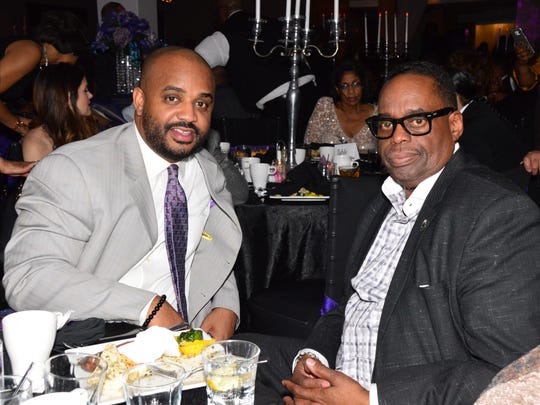
Michigan state Sen. Bert Johnson, D-Highland Park, left, and United Auto Workers Vice President Jimmy Settles at Saturday’s night’s Daughters of Incarcerated Mothers fundraiser.
Bert Johnson & Jimmy Settles
Some of the those attending the Saturday event included Phaedra Parks, of the “The Real Housewives of Atlanta,” O’Neil D. Swanson, president and CEO of Swanson Funeral Home, Wayne County Sheriff Benny Napoleon, UAW Vice President Jimmy Settles, U.S. Reps. John Conyers, D-Detroit, and Brenda Lawrence, D-Southfield, and Detroit City Council President Brenda Jones.

Michigan state Sen. Bert Johnson, D-Highland Park, left, and United Auto Workers Vice President Jimmy Settles at Saturday’s night’s Daughters of Incarcerated Mothers fundraiser.

Gaddis said donations to the Daughters of Incarcerated Mothers can be sent to the EMG Foundation, 615 Griswold, Suite 400, Detroit, MI 48226.

Voting is beautiful, be beautiful ~ vote.©

Monday, December 2, 2019

Was Clayton Luckie Hanging Out With Bert Johnson In Detroit?

From the sentencing in this public corruption case with Ohio Former State Representative Clayton Luckie, I wonder if he was running with Michigan Former State Senator Bert Johnson.

Just asking.

#FreeKwame


Former Democratic State Lawmaker Says He Will Seek Presidential Pardon Of Corruption Conviction


Clayton Luckie
A former Democratic State Representative sentenced to prison after pleading guilty to mail fraud says he did nothing wrong and will seek a presidential pardon.  

Clayton Luckie, who is black, says pardoning him would be a good way for Republican President Trump to show he cares about the minority community.  Luckie was sentenced in November to four months in prison after a judge rejected a probation recommendation. Luckie was convicted of offering his firm as a front for another company to win work intended for disadvantaged businesses and submitted false invoices for thousands of dollars to the City of Dayton.  Luckie left prison in 2016 after serving three years for convictions on charges that included election falsification.

Hometown success story faces possible prison time

NEWS Oct 14, 2012
V
Staff WritersBefore he was led away in handcuffs after being charged with theft in office, money laundering and other felony charges, Clayton Luckie seemed the epitome of the hometown success story.He grew up in a middle-class West Dayton family and played basketball at Chaminade-Julienne High School, graduating in 1981. After serving 10 years on the Dayton school board, he was elected to the legislature representing Dayton’s 39th House District.He drove a Cadillac Escalade, wore finely-tailored suits and bought a home for his mother in Springboro.“I was really impressed by how good he was to his mother,” noted Mario Gallin, who was often an adversary on the Dayton school board. “That seemed counter to his image as the super politician.”Some privately wondered how Luckie’s lifestyle reconciled with his $68,000 income as a state representative and less than $10,000 from his part-time job as director of sales for Johnson Energy Co. “There was always smoke, but I never saw any flames,” Gallin said. “Nothing happened that was anything but proper and above board.”Gallin was among those caught off-guard last week by the news that Luckie had been indicted on 49 criminal charges, including theft in office, money laundering, election falsification, tampering with records, and tampering with evidence and forgery. The indictment says that over his six years in the Ohio House he stole nearly $130,000 from his campaign account.

If convicted, he could spend years in prison.“It’s no secret we weren’t friends,” Gallin said of the six years the two served together on the school board. But, she said, Luckie cared about the school district and was an advocate for children.“He struck me as more of a street politician, whereas I like to think of myself as not a politician at all,” Gallin said in describing their differences.Jeffrey Mims Jr., Luckie’s former third-grade teacher at Eastmont Elementary School and now a member of the state Board of Education, said the person he knows is nothing like the criminal described in the indictment.At Eastmont, Mims said, Luckie used to bring in 50 cents for students who couldn’t afford to pay for their activity fees. In adult life, he served as a mentor for the Beautillion program, which teaches young men to be disciplined.“He was a very caring person,” Mims said. “Over the years I have observed his thoughtfulness and trying to do the right thing for young people. He made me incredibly proud.”

Dayton demolition contractor Steve Rauch, who donated about $10,000 to Luckie’s campaign fund over the years, said he was saddened by the allegations. “This area needs a lot of support, and he was a good person to do it,” Rauch said. “I am sad for his family and for the Democratic Party. He had a nice future, and it might be gone now.”Drowning in debtLuckie was a political survivor. He was the only incumbent school board member who wasn’t voted out when the four-member “Kids First” reform ticket swept the school board race in 2001, led by the late Gail Littlejohn.“He was very charming, and he knew how to work a room,” Gallin said. “People really liked him.”On Nov. 14, 2006, Luckie was appointed by the Democratic Party to the 39th House District seat vacated when Dixie Allen left her seat to run for county commissioner as a Republican. 

He handily won re-election in the heavily-Democratic district in 2008 and 2010 with 81 percent of the vote.He served as Third Vice President of the Ohio Legislative Black Caucus — a group co-founded by one of his predecessors, C.J. McLin. In January 2009, he was appointed to the state Controlling Board.Luckie’s personal life didn’t match the same trajectory as his public life.He bought a home in Dayton’s Wright-Dunbar District for $151,000 in June, 2005, two months before he married LisaBeth Willis. Their daughter, Kierston, was born in March, 2010 — three months before LisaBeth filed for divorce, citing incompatibility.The divorce file made it clear that Luckie was drowning in debt. He disclosed that he faced $10,433 in monthly expenses, including $6,685 in monthly debt payments, $1,928 for mortgages and utilities, $1,220 for gasoline and car repairs on his 2005 Cadillac Escalade, $792 for the car payment and $500 for medical and insurance items. In August 2011, the court ordered the state to begin garnishing $331.50 a month from his wages to cover his child support payments.In the final divorce decree filed in August 2011, Luckie got the houses at 69 Horace St. in Wright-Dunbar Historic District and 8 English Oak in Springboro, the Escalade and half of Lisa Beth’s 401(k) account. 

The pair split $56,000 in consumer credit card debt: $20,000 for her, $36,000 for him.Luckie, now 49, also disclosed on his state ethics form that he has a son, Chris Beam, and he owns a third house at 607 E. Lakegren in Eaton.Luckie soon would have more than just debt problems. In March, he had his first interview with the FBI.Bogus invoicesThe investigation into Luckie stemmed from an FBI probe into lobbying activities by pay day lenders and W. Carlton Weddington, a Columbus Democrat who pleaded guilty to bribery, elections falsification and ethics charges earlier this year.FBI investigators found a $300 contribution to Luckie’s campaign account reported by a pay day lending political action committee but not reported by Luckie. Ohio Secretary of State Jon Husted said his auditors first noted that discrepancy and Luckie then amended his report. 

The FBI’s forensic accountant, though, uncovered evidence of bogus invoices, transfers to Luckie’s personal accounts, ATM withdrawals at casinos in three states and other irregularities, authorities said.The four misdemeanor counts Luckie is facing have to do with filing inaccurate ethics disclosure statements. Luckie failed to disclose four loans: $4,000 with Union Savings Bank to purchase a jet ski, $3,000 with a Dayton jewelry store, $4,000 with a roofing company, and $5,000 with Frank V. Surico.Surico is listed as vice president of Johnson Energy Co., a dealer in coal, limestone and other fuels. The company has employed Luckie since at least 2005, according to state ethics statements, and lists him as the director of sales on its website. But the job hasn’t paid much. Luckie said on his ethics statements that he earned between $1,000 and $10,000 a year from Johnson Energy in six of the last seven years and in 2008 he said he made between $10,000 and $25,000 at the job.Surico wrote a $625 check to the Ohio Legislative Black Caucus in 2011 to support its annual golf outing, but Luckie deposited the check into his own bank account, according to the indictment.Tony Bledsoe, director of Ohio’s Joint Legislative Ethics Commission, said he’s troubled by the Weddington and Luckie cases, but he doesn’t believe there are widespread abuses at the Statehouse.“There is always a concern about any potential violation of the public trust,” he said. “But with 132 legislators, there will probably be a couple of folks who step outside the boundaries of what is appropriate or what is legal. These are isolated incidents, but we need to know how we can improve our oversight.”Bledsoe said the FBI has voiced no concern over Luckie’s role on the state Controlling Board. 

“One of the checks and balances is the state checking account,” he said.Fundamental trust violatedDayton City Commissioner Nan Whaley said the allegations are baffling, considering how hard it is for candidates to raise even the smallest amount of money. “These dollars are really precious,” Whaley said. “It’s not easy to raise money, and it’s something we don’t like as part of the job. If these charges are true, it’s really strange. Why would you do that?”Whaley praises Luckie for stepping aside in time for the Democrats to place another candidate, longtime Dayton politician Fred Strahorn, on the ballot. “It’s a relief that we are moving on with a good candidate,” she said. “I give Clayton credit for that. He did have the community on his mind.”Derrick Foward, president of the Dayton chapter of the NAACP, said the NAACP is not involved with the case. But Foward, who grew up with Luckie, said, “We are praying for him and his family. We will be very careful about making statements until all the facts are known.”He added, “If he feels he is unjustly treated, the NAACP is here for him.”Foward said that Luckie was known in his youth as an respected middle-class teen who loved basketball, swimming and dances at the West Area YMCA. “It’s a great loss to the community,” he said. “He was an upstanding citizen.”Husted, however, said on Friday that he was not surprised by the indictment. “I really don’t want to expand on that publicly,” said the former House speaker who has known Luckie since the 1990s.Husted said he will ask the General Assembly next year to work on reforming the campaign finance reporting system. 

One change he supports: requiring campaigns to disclose bank account information so that auditors can verify expenditures and contributions if necessary. He said also Ohio needs to update its laws for more timely disclosure of campaign contributions and beef up enforcement.“Not only do we need a reform in campaign finance on the auditing side, but also on the enforcement side,” Husted said. “(Franklin County Prosecutor) Ron O’Brien did a really good job because it got to the prosecutors through the law enforcement side.”Usually campaign finance complaints go through the bipartisan Ohio Elections Commission, Husted said, which can take months or even years to resolve cases.Former Cuyahoga County sheriff Gerald McFaul, a Democrat, stole money from his campaign fund and forced employees to work on his political events. He struck a plea deal with prosecutors in 2010 that included $130,000 in restitution.Husted said the Elections Commission ruled that McFaul could use his campaign funds to pay the restitution. 

Husted has asked for a re-hearing on the matter, he said.“If you get caught doing something wrong and the penalty is pay the money back, that’s not much of a penalty,” he said.Husted said Luckie is eligible to pay his attorney fees out of his campaign fund because the accusations are related to his activities as a candidate and an officeholder.Whaley said that if the allegations are true, Luckie violated the fundamental trust between donor and politician.“I would be really upset if I had ever given Clayton any money,” she said. “There is a code that if you’re donating money, it’s for the campaign.”

Voting is beautiful, be beautiful ~ vote.©

Saturday, August 31, 2019

What Do The Members Of The Michigan Payroll Fraud Unit Have In Common?

Stop Payroll Fraud Theft final logo
Report Michigan Payroll Fraud
Q: What do the members of the Michigan Payroll Fraud Unit have in common?

A: Child Welfare Fraud in School, of course.

Michigan business engage in so much payroll fraud the Attorney General had to create the Michigan Payroll Fraud Enforcement Unit?

What I found to be of interest were the members of the Unit.

You have Detroit's own, fashion show selfie queen, Sherry Gay Dagnogo, who will do anything for a photo op while covert ops are run right in her face.

You have Jim Ananich, who succeeded John Gleason, who has a fund for organs and kids which is not registered anywhere, and just so happened to work for Dan Kildee, the spokestoken for the original concept of the Genessee Land Bank Authority for the State of Michigan under the Emergency Manager Law, where he has lots of experience.

Then you have Christine Greig who seems to know about St. Vincent Sarah Fisher and its "educational" issues through her foundation.

I believe the convening of this board is more than just to stop payroll fraud, which is actually a scourge upon Michigan and across the country, as seen in the Congressional Credit Union, the Office of Personal Management and income tax fraud, because each member has a unique background in the Michigan history of stealin' the children, the land and the votes through privatization.

They all are attached to foreign foundations.

This looks like a Mueller production, but, hey, what do I know?

I know Dana looks like a whistleblower.

I bet this unit was inspired by Bert Johnson.
Payroll Fraud

Owner of small Lansing business says payroll fraud charges stem from accounting error 


LANSING - The owner of a Lansing business faces a bevy of criminal charges over what the state calls payroll fraud but what he described as a payroll and accounting mistake.

The charges against Camron Gnass, founder of Traction Partners, a small branding and design studio, are the first to be brought by Attorney General Dana Nessel's Payroll Fraud Enforcement Unit, her office said in a news release.
Senator Jim Ananich

Senate Democratic Leader
Jim Ananich

Gnass faces 13 felony counts, including one count of racketeering and four counts of larceny by conversion, court records show. The racketeering charge is punishable by a maximum 20 years in prison upon conviction.

An investigation by the U.S. Department of Labor showed that between 2008 and 2017, Gnass failed to put money into the retirement accounts of at least two employees, even though money was deducted from their paychecks for that purpose, officials said.

The AG's office said the withheld funds went into the business' account and were used by Gnass "for his own personal gain."
Christine Greig

House Democratic Leader
Christine Greig

In a statement emailed to the State Journal, Gnass said the charges resulted from an error in the company's payroll and accounting systems. No one noticed the problem until it was brought to his attention by a former employee, he said.

"I have been working diligently to repay this debt ever since that time," he said. "The former employees have been a part of the reconciliation, and we've worked within the guidelines of the volunteer correction program with the IRS to rectify. I value each one of my employees and the work they do for our clients and our community."

Sherry Gay-Dagnogo circle

Detroit Caucus Chair
Sherry Gay-Dagnogo
A total of about $37,000 was withheld from those employees, and the money went into a business account and was never used for personal expenses, he added.

Those funds were "fully repaid" in April, along with the company's matching portions totaling about $19,000, according to Gnass' statement.

"At no point" did anyone in Nessel's office contact him or anyone else at the company about the investigation, he said.

The charges against Gnass were filed Wednesday in 54A District Court. He had not been arraigned as of early Thursday afternoon.

Voting is beautiful, be beautiful ~ vote.©

Saturday, June 15, 2019

Cocktails & Popcorn: Kwame Kilpatrick Has Many Tales To Tell - Detroit Brady Impeachment Dilemma Continues

Image result for kwame kilpatrick hip hop
Kwame Kilpatrick
Former Mayor of Detroit
ready to serve up some of that
brandy impeachment
It seems Kwame Kilpatrick has much to say.

I do not believe he was ever allowed to tell his tale, considering the fact that the federal government was dealing with an ongoing investigation, which forced its hand to sit on exculpatory evidence, that they had no idea about at the time.

This is about that Detroit Brady Impeachment Dilemma.

This is about to get juicy because everyone knows Kwame is not the sharpest knife in the kitchen drawer.

I have always said that he was groomed by what we call the McNamara Kingmaker.

Just another operation that was being run to cover up the stealin' of the children, the land and the votes.

This is when the "Legal Geniuses" (trademark pending) began setting up the Detroit Land Bank Authority, right in the midst of the fake mortgage and property tax schemes that led right to that fake ass Bankruptcy and Grand Bargain.

In this video, Kwame is calling out contracts and NGOs, that he probably does not have a clue about considering the internet was not rocking in public search databases at the time.

There are still to this day, politicians, like his cousin Bert Johnson, who got propped up as one of those sad sacks of potatoes you throw under the bus so everyone runs over to get their does of fear porn, while the Meanies go running off in the other direction setting up another complex financial fraud scheme that I have so readily boiled down to be known as stealin'.

There are former Corporate Counsel individuals who have unaddressed public allegations of stealin'.

There are former Michigan Democratic Party leaders who have issues with stealin'.

There are current Michigan Republican Party leaders who also have histories of stealin'.

Oh, the oh so many "Elected Ones" whose tales of stealin' could be preserved in the historic record.

Kwame knows everyone, all over the world.

He was the Big Baller Hip Hop Mayer.

Oh, the stories he shall tell.

I am quite sure Trump would just adore preparing a venue for public listening to each and everyone of them.


I have heard tales that Kwame immediately requested transfer to a Texas facility upon his incarceration because there were individuals who were tasked with silencing him.

But, hey, what would I know?

I know Kwame knows Janice Winfrey.

Voting is beautiful, be beautiful ~ vote.©

Thursday, November 29, 2018

More Corporate Shape Shifters: Another Set Of LLCs Stealin' Detroit Properties From The Poors

Much love to Allie Gross for another fabulous piece of reporting.

She should interview Bert Johnson when he gets out of prison for the holidays to get more, detailed information on how these fake land contracts and fake LLCs were stealin'.

I believe he is a subject matter expert.

Oh, and so is Adam Hollier.

Detroit land owner Michael G. Kelly sued over 'predatory' contracts

A lawsuit filed in federal court this week takes aim at Michael G. Kelly, one of the top landowners in Detroit, over contracts for housing that the suit calls "predatory."

The suit filed Monday by Mantese Honigman and Michigan Legal Services seeks class-action status and alleges that Kelly and four other defendants lured unassuming and vulnerable Detroiters into a "real estate bait and switch" in violation of the Truth in Lending Act and the Home Ownership Equity Protection Act.

At the crux of the complaint is the use by Kelly — and the various LLCs associated with him such as Detroit Property Exchange — of contracts that seem to operate outside of federal regulations, contracts Joe McGuire, an attorney at Michigan Legal Services who focuses on housing issues in Detroit, says are actually land contracts, which would have some consumer protections.

"The question that this litigation raises," said McGuire, "is can a property like Detroit Property Exchange get around the regulations that were passed by Congress specifically to address predatory lending, like this, simply by renaming the agreement to something other than land contract?" 
The Detroit Free Press reached out to Kelly for comment via the Detroit Property Exchange but did not hear back.

Land contracts are  popular home-buying tools in Detroit where mortgages have historically been hard to come by. They often operate in a nebulous legal space and leave little protections for buyers (called vendees). They also often result in evictions.

But, according to McGuire, a general land contract pales in comparison to the  vague and confusing agreements Kelly uses in his land deals.

"Often, when people hear about land contracts, if all they're used to is your conventional mortgage, they are struck by how much worse a land contract is in the way it's written," McGuire said. "They balk at the idea that you only get your deed when it's paid all off, and that there is no appraisal required, no inspection in the law. But these agreements (used by Kelly) make land contracts look amazing."

According to the complaint filed in U.S. District Court for the Eastern District of Michigan, the deals would work like this: 
  • Kelly (or one of his companies) would purchase homes, often sight unseen, at the Wayne County Tax auction for a low price. The homes are usually dilapidated. 
  • After attracting a potential buyer, Kelly (or one of his companies) would have them sign an "ambiguous, opaque contract" with a high interest rate. 
  • Under the contract, the purchaser would be under the impression that after several years of payments they would own the property, and that in the interim, as the future owner, they would be responsible for fixing up the property.
  • When the buyer "inevitably" got behind on payments "due to their general lack of an ability to pay back the loan," Kelly (or one of his companies) would evict the purchaser as a tenant, rather than a land contract vendee, who would have more time to catch up on payments before being evicted.
  • The tenant's eviction would go unquestioned because of the contract's "intentional use of ambiguous, confusing, cherry-picked language." Adding to the chaos is the fact that purchasers would have typically signed two documents when committing to the property: a "Lease with Option" and "Real Estate Purchase Agreement." One makes the customer a tenant; the other makes them a purchaser — together they created confusion. 
  • Once the "purchaser" had been evicted, the complaint alleged that the scheme would begin again with a new potential buyer.
While the complaint states the deals were predicated on buyers never actually getting the property, a land contract-like agreement was used instead of a rental agreement because it was more lucrative for the defendants.

Michigan law prohibits landlords from collecting a security deposit greater than 1.5 times the monthly rent, but the seller of a land contract can ask for a "nonrefundable down payment" at a cost far greater to the purchaser.

"Defendant sold plaintiffs and the class members home ownership but evicted them as tenants," the complaint said, noting that Detroit Property Exchange, one of Kelly's businesses, has a ratio of 1.49 "evictions" for every property in their portfolio.

Ultimately, according to the complaint, the contracts acted as "high-cost mortgages" and served to originate loans (the monthly bills "buyers" received often had "loan numbers" on them).

Because of this, the complaint states, the Truth in Lending Act — a 1968 federal law aiming to protect consumers in dealings with lenders and creditors — and the Home Ownership Equity Protection Act — a 1994 amendment to the Truth in Lending Act that tackles abusive practices with high-interest rates — should apply.

And because many of the potential buyers could not reasonably make the monthly "rent-to-own" payments — and no consumer financial data was reasonably collected or analyzed — the complaint states the land contracts were ultimately predatory.

The four other defendants are  entities Kelly uses for his land contract business — Detroit Property Exchange, Suena Homes Realty LLC and Homes of Detroit LLC — and Crystian Segura, a licensed real estate agent and property manager for a Kelly real estate company.

The representative plaintiffs are Natalie James, Jerome Day and Carl Austin. All three entered into contracts with the defendants. The complaint seeks class-action certification and the plaintiffs are requesting a jury trial.

A costly route to home ownership

In the United States, land contracts — also known as a contract for deed — were popularized between the 1930s and 1960s as a tool for African-Americans who were prevented from accessing traditional mortgage loans to buy homes.

It is estimated that in Chicago during the 1950s, 85 percent of properties bought by African-Americans were purchased using land contracts.

While land contracts have ebbed in popularity over the decades, especially following the subprime foreclosure crisis that placed constrictions on mortgage lending, they've seen a resurgence as a tool for individuals who cannot obtain conventional home financing.

This is particularly the case in Detroit, but how many have been issued over the years is not known because Michigan law does not require land contracts to be filed with any governmental entity.

"Land contracts can be so pernicious — there is no filing requirement, there is just no regulation on them," Peter Hammer, director of the Damon J. Keith Center for Civil Rights at Wayne State University Law School, said this summer for an article on property speculation in Detroit.

"They can just exist in this completely private space."

Under typical land contracts, the seller holds the deed to the property until the contract — a certain purchase price at an interest rate over a series of years — has been fulfilled. Despite not having a legal title to the house, the buyer, or vendee, is typically obligated to pay property taxes, obtain homeowners insurance and make repairs.

Language within land contracts varies, but it typically includes, as explained in the complaint, vague wording that favors the seller.

"If the buyer defaults during the term of years, the contract usually purports to allow the seller to cancel (or "forfeit") the land contract, keep all payments made by the buyer and evict the buyer through a forfeiture proceeding," the complaint explains.

Land contract forfeiture actions give a vendee 90 days to repay what is owed (180 days if they've already paid 50 percent of the purchase price by the time the case goes to court).

But Kelly has treated the agreements he has made as tenant-evictions, the complaint states, which give tenants only 10 days to pay what is owed.

Ultimately, the complaint states, the agreements — despite their names — are land contracts. 
"The reason that these are land contracts, despite the fact that they slapped a different name on top of it," McGuire said, "is they operate exactly like land contracts."

He said that   following the housing crisis, regulations were passed  targeting land contracts.

As a reaction, those utilizing them began to call them something else.

“It’s pretty common knowledge that this is what drove a lot of these companies that were former land contract sellers to instead start calling these contracts 'lease with option to buy' or 'rent to own' instead of land contracts,” McGuire said.

But, he added, "if you look at the paperwork Detroit Property Exchange gives these customers, they have amortization schedules, they have statements that refer to a loan number, they have (an) interest rate and how it’s being applied to the purchase price; they even in one case ... gave the customer the required IRS form for writing off mortgage interest on income taxes," said McGuire.

"Everything they're giving the customer gives them the impression that they're buying property," McQuire continued. "And ... from what I've heard, when the customer is going in, the agreements are referred to as land contracts. You're told you're buying a property."

They therefore should be subject to federal consumer protection laws that require certain disclosures and evaluations around a customer's ability to repay the loan, the complaint states.

Exploiting buyers

"For buyers, the land contract represents an opportunity to own their homes," Josh Akers, assistant professor of Geography and Urban Regional Studies at the University of Michigan-Dearborn, and Eric Seymour, a postdoctoral research assistant at Brown University, wrote in a 2018 paper on land contracts that the complaint cites. "For unscrupulous agents, it is an opportunity to profit through exploitation and eviction."

In 2017, efforts to regulate land contracts never came to be, according to Lorray Brown, co-director of the Michigan Law Poverty Program, who was working on draft legislation.

"The draft legislation never made it out of the work-group meetings" as there was a lot of opposition "from the industry folks," Brown said this summer, noting that she has seen a number of private investors purchasing uninhabitable and dilapidated foreclosed homes and selling them to consumers under land contracts.

"These land contracts are predatory because they are set up to fail," she said, explaining that the contracts often require consumers to take on all of the obligations of a homeowner with none of the rights.

"The terms of the contract require the consumer to fix up the property within a reasonable time. Then there is usually a provision that says if the consumer fails to comply with any of the provisions, the contract will convert to a month-to-month tenancy and the seller will terminate the contract. The seller then takes back the property through eviction and the consumer loses all of the money invested in repairing the property," Brown wrote.

NameCompanyPipelineProperties
John HantzHantz FarmsTax Foreclosure1,941
Manuel MorounVariousTax Foreclosure1,208
Melvin WashingtonVariousGovernment665
Michael KellyVariousTax Foreclosure534
Dennis ElliottAsset Managers DirectREO391
Matthew TatarianVariousTax Foreclosure344
Bert Dearing Jr.VariousTax Foreclosure304
Stephen HagermanBrick Homes, Unique Homes, OtherREO207
Leslie CoxonHome Source DetroitREO177

Kelly, according to Akers, is one of the more "sophisticated" speculators working in Detroit. 
"He's not just engaged in a single practice like the one called out here in the complaint, but he also purchases vacant land near potential development sites, he finds wrinkles in land records. He's notorious for purchasing parcels within parcels in the land auction," Akers said, pointing to a 2011 Detroit News article that detailed this unusual practice where Kelly has been known to find anomalies in the tax auction — single parcels within a business's larger footprint — and then scooping them up with the intention of selling them back to the buisness at a premium. He notably did this in 2006 with a parcel within a strip club's parking lot. He bought the land for just over $1,000 and sold it back to the club for $19,000.

Today, Akers said Kelly owns roughly 500 properties in Detroit. At the peak of his two-decades of buying properties in the Wayne County Tax Auction, Kelly had more than 1,150 parcels, according to the complaint.

"He's one of the earliest and most recurring characters in the auction showing up in person for days with a team of people going back and forth looking over things and just acquiring lots of properties," said Akers.

Voting is beautiful, be beautiful ~ vote.©

Tuesday, September 11, 2018

Cocktails & Popcorn: Bert Johnson Made A Video To Expand His Investigation

Cool story, Bruh.


I sit with baited breath, waiting to hear their stories.

Political pals helped spare Johnson stiff prison term

Janee Ayers
Detroit — Several elected officials and political heavyweights, including former Detroit Mayor Dave Bing, helped disgraced state Sen. Bert Johnson dodge a stiff prison term by writing supportive letters to the court.

More than two dozen letters were made public Monday and revealed that politicians, including Detroit City Council members Scott Benson and Janee Ayers, used city letterhead while writing letters supporting Johnson's plea for leniency.

The letters were made public four days after Johnson was sentenced to 90 days in a county jail for stealing more than $23,000 from taxpayers by adding a ghost employee to his senate payroll. U.S. District Judge Matthew Leitman cited the letters, saying that without the personal appeals, he would have sentenced Johnson to as much as 12 months in federal prison.

Johnson received support from numerous Democratic Party heavyweights and a broad cross-section of the community: local and state politicians, a lobbyist and relatives who backed a corrupt politician with a rap sheet, a chronic list of bad debts and the worst attendance record in the state Legislature.
“In my conversations with Bert he realizes he made a mistake, but I hope you will exercise the greatest level of leniency in your sentencing of Mr. Johnson," Benson wrote. "Even though a sever (sic) lapse of judgment has occurred, Bert is not a threat to society and his community can best be served by him remaining free."

Ayers called Johnson one of her best friends.

“Bert has been a mentor and a strong pillar within the community that he represents and throughout the state," Ayers wrote.

In an interview Monday, Ayers said she didn’t think there was anything wrong with using city letterhead since the letter was coming from two vantage points; in her official capacity as a council person as well as on a personal level.

“It was an official letter coming from me as a council person. I didn’t think of it as infringing on any rules,” Ayers said. “I wrote the letter as a council  member and I printed it out on my letter head as a council person. If it is a negligence in using that, I apologize. I didn’t think about it from that perspective.”

Bing, meanwhile, wrote that Johnson was a hard-working legislator who fought for constituents.
“I am aware that Bert has pleaded guilty; but would hope that his political background, his public service, as well as his overall commitment to his community be considered and, therefore, allow for leniency regarding his sentencing," Bing wrote.

Johnson's public service outweighed his crimes and rap sheet, which includes a teenage conviction for armed robbery, Johnson's defense lawyer John Shea said last week.

“Please do not allow this recent indiscretion tarnish the good that Mr. Johnson has done as a state representative and senator," Highland Park Mayor Hubert Yopp wroteon city letterhead.

State Rep. Jewell Jones, a first-term Democratic lawmaker from Inkster, called Johnson a "gladiator."
36th District Court Judge William McConico 
“It is times like now when we need powerful, respected leaders in our nation, I believe it would be a disservice to the public to lose a gladiator like Bertram Johnson," Jones wrote. "Godspeed!”


William McConico, a 36th District Court Judge in Detroit, cited his friendship with Johnson while urging leniency.

“I ask you to take into account that Bert is much more of an asset within the community than away from it,” McConico wrote.

Johnson fought for the poor and children, wrote former state Rep. Phil Cavanaugh, who works for the Wayne County Treasurer’s Office.

“I believe that Bertram Johnson is truly remorseful for any wrongdoing,” Cavanaugh wrote.
A new documentary raises questions about Johnson’s remorse.

Speaking directly to the camera at some point after his indictment but prior to his conviction, Johnson says he went to the Capitol “every day trying to make a difference, trying to make a change” and help constituents.

“And somebody wants to take it away from you? Somebody wants to say you’re not the guy anymore? Frustrated is not the word. It’s (expletive).”

Voting is beautiful, be beautiful ~ vote.©