Showing posts sorted by date for query Bill Johnson. Sort by relevance Show all posts

Sunday, October 11, 2020

Prelude To Detroit: Karen Dumas Has Entered The Stage

Karen Dumas
The following article is from 2010.

I found it because Karen Dumas has entered the stage.

Dave Bing was falsely advised.

As a matter of fact, he was terrified.

I know.

He whispered, in my ear, his prayer, and sealed it with a kiss on my cheek, which is why I am still on that mission because they were mean to my Sweetie.

Below, is a list of the names of individuals who falsely advised the Mayor of Detroit, but the only reasons I am preserving this is because they are of the same cloth of the individuals who have and continue to falsely advise Trump because they are the ones who executed, on the ground floor, the fake ass property tax foreclosures, right after the fake ass  mortgage foreclosures, the fake ass Detroit Bankruptcy and the fake ass Detroit Bankruptcy creditors of the fake ass Detroit Land Bank Authority.

Oh, and I cannot stand Rip "The Rip Off" Rapson.

Karen has a tale to tell.


#perkinscoiesucks and so does JonesDay.

#maytheheavensfall

Detroit Mayor Dave Bing urged to keep land-use plan process open

Advocates say residents fear being uprooted

Attendees of Detroit Mayor Dave Bing's land use summit: 

• Marcell Todd, director, City Planning Commission 
• Eugene Jones, executive director, Detroit Housing Commission 
• Anita Lane, project manager, Community Development Advocates of Detroit 
• Steve Ogden, executive director, Next Detroit Neighborhood Initiative 
• Linda Smith, executive director, U-SNAP BAC Inc. 
• Tom Goddeeris, executive director, Grandmont Rosedale Development Corp. 
• Heidi Mucherie, executive director, Community Legal Resources
• Aundra Wallace, member, Detroit Land Bank Authority 
• Burney Johnson, deputy director, Michigan State Housing and Development Authority 
• Kathleen Lomako, deputy director, Southeast Michigan Council of Governments 
• William Hunter, analyst, Data Driven Detroit 
• Ann Lang, CEO, Downtown Detroit Partnership 
• Faye Nelson, president and CEO, Detroit Riverfront Conservancy 
• Don Edwards, founder, principal and CEO, Justice and Sustainability Associates, Washington, D.C. 
• Jessica Green, of the Detroit Collaborative Design Center, University of Detroit Mercy 
• Charles Cross, research and design fellow, Detroit Collaborative Design Center, University of Detroit Mercy

The community advocates invited to a land use summit at Detroit Mayor Dave Bing's office last week had a few words of caution for him: Don't make assumptions. Include the community in the conversation. Stay away from business jargon. 

Urban agriculture may not be the answer. 

The city, attendees said, should also move quickly to develop a positive message and terminology around the idea of developing a long-term land use strategy that will see some parts of the city mothballed and other neighborhoods bolstered. 

Rumors have flown that city officials had a plan to reshape Detroit, or were developing such a plan in secrecy, fueled by the city's hiring of a Kresge Foundation-funded urban planner. 

Until last week, the administration hadn't said much. Bing has said that among Detroit neighborhoods there will be “winners” and “losers,” that the city lacks the revenue to support its 139 square miles, and most often, that there's not a plan to shrink the city. 

“I want to start by making one thing perfectly clear,” Bing told the group at a meeting on May 12, which was not open to the public. “There's been a lot of conversation about ‘the plan.' For all of you, there is no plan. … I think there are a lot of people in the media and in the community, people from all across the country, who are under the impression that we have a master plan for land reuse. This is just the beginning of the development of that plan.” 

The assembled group, above, will serve as the mayor's advisory team. 

Bing's team also plans to assemble a citizen advisory group. 

City leaders have thus far declined to give a name to the process. In that absence, terms like “downsizing,” “shrinking” or “rightsizing” frequently are used. 

But those words, the advocates said, rub residents the wrong way. 

“The words you use are very important,” said Heidi Mucherie, director of the Detroit-based nonprofit Community Legal Resources. “There's a lot of pushback on ‘downsizing' or ‘shrinking,' and some people are embracing words like ‘re-envisioning' or ‘revisioning.' There are some people who said look, don't give this a fancy word, this is planning, so call it planning.” 

Mucherie told Bing and his team that she observed two pervasive fears at a recent meeting held by her group. “(Detroiters) felt strongly that residents should lead the way, that the process should not be led by ‘outsiders' — and that could mean philanthropy, it could be consultants,” she said. “The other fear is the fear of land-grabbing and the fear of being involuntarily displaced.” 

Some concerns aren't entirely unfounded. 

While the city doesn't want to involuntarily relocate residents, said Karen Dumas, Bing's group executive for communications, “Nothing's off the table.” Business jargon like “rightsizing” or “downsizing” doesn't calm fears, said Tom Goddeeris, executive director of the Grandmont Rosedale Development Corp. “In the general population, rightsizing is a euphemism for layoffs,” he told the mayor. “It comes from the business community. … I also think you need to be careful about using too much business jargon. I know you're obviously a successful businessman, and you're using a business model for the city, but you need to be careful about business jargon. It makes people think it is all a front for big corporations that are going to grab all the land.” 

Mucherie also urged city officials to approach the community without preconceived notions. Some Detroiters, she said, are put off by the idea of creating density. “They don't want to live in a dense neighborhood,” she said. “We heard from other citizens that they are furious about farming and urban agriculture being offered as a solution. That's not to say everyone feels that way, but … just because there are people out there who have advocated a solution doesn't mean this community has embraced it. You need to be very careful not to take assumptions to the community.” 

Development of the plan will take 12 to 18 months, Bing said, and will be led by Marja Winters, deputy director of the city's Planning and Development Department, and Toni Griffin, the nationally recognized urban planner whose salary is paid by Troy-based Kresge. 

Kresge will also foot the bill for a team of technical advisers to work on the plan and a community engagement effort, Winters said. 

The advisory team will meet regularly to vet plans or suggestions developed by Griffin and a team of technical consultants before such items are incorporated into the plan. 

The group's next move will be to weigh in on a formal community engagement strategy. 

A request for such proposals has been made through the Kresge Foundation, but no companies have been chosen, Winters said. Kresge Communications Director Cynthia Shaw wrote in an e-mail to Crain's that costs for the consultants haven't yet been finalized, saying Kresge hopes the costs ultimately will be paid in concert with other foundations through a grant to a nonprofit organization. 

Openness and transparency are key, Bing said. “I think people feel like this group in particular is a secret agent for this administration, that we're going to come out with this plan and keep it close to our chest and nobody's going to know about it — won't work,” he said.

 “We've got to be transparent, and we've got to be inclusive.” Linda Smith, executive director of U-SNAP-BAC Inc., urged the city officials to develop a positive branding message. “What's the tag?” she said. “Something you can put on buses, something you can put on billboards. People have to get excited. Detroiters haven't been excited in a long time and it makes them negative.” 

Developing a formal method for citizen input is crucial, said Anita Lane, project manager at Community Development Advocates of Detroit. “We want to be really creative about how we engage citizens and how we engage young people” she said. “I think it's important that we find a way to interact with the community. … Unless that happens here as well you will have a lot of pushback, and the plan may not succeed.”

Voting is beautiful, be beautiful ~ vote.©

Wednesday, July 1, 2020

Prelude To Detroit: FBI Arrest Toledo City Council Members

Waiting for Detroit....

#mayheavensfall


Federal agents charge four Toledo city council members in bribery probe

The FBI has arrested multiple Toledo city council members accused of taking cash in exchange for votes during what is described in court records as a years-long, sweeping bribery scandal involving some of the city’s highest elected officials.

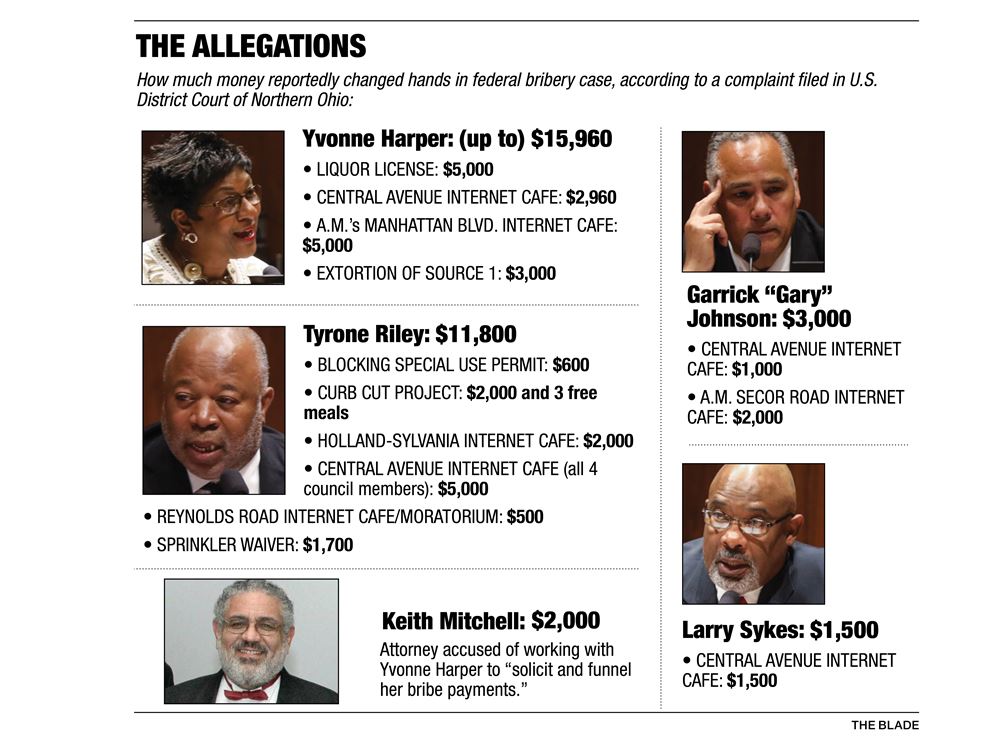
City council members Tyrone Riley, Yvonne Harper, Larry Sykes, and Gary Johnson are all charged in federal court with accepting bribe payments for official acts and extortion, according to criminal complaints filed Tuesday. Keith Mitchell, an attorney who is accused of funneling bribes to Ms. Harper, also faces bribery and extortion charges. Ms. Harper is charged as well with interstate communications with intent to extort.


There was no answer at the Grand Avenue home listed for Keith Mitchell, an attorney, in Toledo on Tuesday. The FBI has taken multiple city councilmen in custody in a bribery case.

Attorney facing charges has history of involvement in council issues
FBI Special Agent Eric Smith in a Tuesday afternoon news conference said the councilmen were arrested without incident earlier in the day, while authorities are “actively seeking the whereabouts of Keith Mitchell.”

He said the councilmen committed a “fundamental breach” of the oath they took upon taking office, and violated the public’s trust for their own personal gain. The maximum prison sentence for bribery is 10 years, while the maximum for the extortion charge is 20.

Ms. Harper could face an additional two years in prison for the additional charge.

Details in the complaint suggest up to $34,260 changed hands between business owners, the councilmen, and Mr. Mitchell during the course of the investigation.

“The residents of Toledo should know, as should every other resident of the Northern District of Ohio, that where there are allegations of public corruption and kickbacks, we and our federal partners will be there every time,” U.S. Attorney Justin Herdman said in a statement.

The four council members appeared before Magistrate Judge James Knepp II by video conference in U.S. District Court in Toledo on Tuesday afternoon.
Image Description
U.S. Assistant Attorney Michael Freeman said the government did not seek detention for any of the defendants. Each councilman was released on a $50,000 unsecured bond, meaning if they fail to appear in court, they owe the government that much money. Additionally, they were barred from out-of-state travel and from having contact with co-defendants, victims, and witnesses.

Toledo bribery scandal rocks Lucas County's long-dominant political party

“I don’t know anything; I don’t know how this came about,” Ms. Harper told The Blade as she left the courthouse Tuesday afternoon.

She would not address the accusations of soliciting bribes, nor would she say if she will step down from her post on council.

Her attorney, Jon Richardson, could not be reached for comment. Ronnie Wingate, an attorney representing Mr. Sykes, declined to comment.

Both Mr. Riley, himself an attorney, and Mr. Johnson did not yet have legal representation but are expected to hire lawyers.

Toledo Mayor Wade Kapszukiewicz said in a statement that he was “shocked and heartbroken by today’s arrests.”

“This is a terrible day for Toledo — and for everyone who believes in the good that can be accomplished through public service,” he said.

Matt Cherry, president of city council and a Democrat like his accused colleagues, said he and other councilmen are cooperating with the investigation.

“Corruption of any kind cannot be tolerated and has no place in the government of Toledo and Ohio,” he said in a statement.

Court records suggest that one council member — Mr. Riley — has been soliciting bribes since at least 2013. It was Mr. Riley’s actions that also seemed to initially draw the attention of the FBI.

The criminal probe appears to have started on March 5, 2018, when a federal agent interviewed an unnamed source who owns several commercial properties, primarily gas stations and convenience stores, within the city. That person, who was arrested in 2018 for being in the United States illegally, reported previously providing things of value to Mr. Riley in exchange for his vote on matters before council.

Investigators noted that they believe the source married a U.S. citizen in 2000 with the sole intent of obtaining immigration benefits, but was denied lawful permanent resident status based on the fraudulent marriage, which was denied. The source has remained in the United States without lawful immigration status and is still subject to criminal and immigration consequences, according the complaint.

The source in 2013 purchased a gas station and convenience store on Dorr Street. Shortly thereafter, another business wanted to open a competing store nearby, but needed city council to approve a special use permit.

When the source asked Mr. Riley to vote against the permit, the councilman asked for a political donation, according to a criminal complaint.

The source wrote a $300 check to Mr. Riley, the complaint states. Additionally, Mr. Riley asked the source if alcohol could be delivered to the source’s business for Mr. Riley’s upcoming fund-raiser.

"Source 1 opined Riley did so in order to avoid paying the requisite taxes on alcohol by having the alcohol delivered to a liquor license holder. Source 1 agreed to accept the delivery of alcohol," according to the complaint.

Mr. Riley also requested that the source pay the delivery fee of $300. The source agreed, as long as Mr. Riley didn’t cash the $300 check he/she just provided, court records state. Still, Mr. Riley cashed the $300 check, and the councilman did not reimburse the source for the delivery fee, in essence taking $600.

In May, 2018, the source filed paperwork with the city requesting a "curb cut ” — a small ramp built into the curb of a sidewalk — be placed near a Dorr Street gas station in order to increase traffic flow into the business. The business was in Mr. Riley's district and such a request required a special permit that needed approval from city council.

Prior to the vote on May 23, 2018, the source met with Mr. Riley for lunch to discuss the matter. Mr. Riley expressed his support for the project. After the meal, Mr. Riley never attempted to pay for his portion of the approximately $130 restaurant bill, according to court records.

“Mr. Riley then ordered a meal (prime rib and carrot cake) ‘to go,’ knowing source 1 would pay for it,” a complaint states.

During a conversation in the parking lot, Mr. Riley also told the source he wanted $2,000 to be delivered to a family member.

During a second lunch meeting on May 31, 2018, the source provided Mr. Riley with $2,000 and informed Mr. Riley that it was the money, “for his support,” according to court records. A second unnamed person, identified as ‘middleman 1’ in court documents, joined the source and councilman for lunch then added $1,000 for Mr. Riley to accept a total of $3,000.

The middleman was directed to take the $3,000 in lieu of Mr. Riley accepting the funds in a public setting, records show. The middleman then purchased four $500 money orders with the money, forging the source's name as the purchaser with the money orders payable to Mr. Riley.

Over several months, Mr. Riley deposited $1,500 worth of money orders in his “Riley for Council,” account and then deposited the other $500 money order in his “Smith Park Community Coalition” account. Mr. Riley hosts an annual family festival at Smith Park in his district, which includes a bicycle giveaway for kids.

On Dec. 10, 2018, an FBI agent approached the middleman, who admitted to paying bribes to Mr. Riley and acting as a conduit to funnel bribes to the councilman, according to the complaint. That person then agreed to cooperate with the FBI investigation, becoming identified as source 2 in court documents.

Source 2 does not have a criminal history, however his/her actions prior to cooperating are subject to criminal penalties. Internet cafe businesses, which source 2 operated, may be in violation of federal or state gaming laws, records show.

The next day, source 2 spoke to Mr. Riley about the curb cut and indicated the first source was willing to pay more money if necessary.

On Jan. 2, 2019, source 1 — the owner of the Dorr Street gas station — again met for lunch with Mr. Riley to discuss the May, 31, 2018 bribe payment.

The councilman reassured source 1 that he would take care of everything necessary to get the special permit approved, records show. He also asked the source to financially support a re-election event and again left without paying for his meal.

On April 30, Mr. Riley informed source 1 that he garnered enough votes for council to support the curb cut permit, but that he would have to abstain from voting, according to the complaint. He later told the source that his abstention was to make sure that was no “appearance of impropriety.” City council approved the special permit but source 1 was required to install a sprinkler system on the property.

The gas station owner then met with Mr. Riley for lunch on May 9, 2019, thanking the councilman for his assistance. Mr. Riley again left the restaurant without paying for his meal, and added a piece of carrot cake "to go," according to the complaint.

On Tuesday, Mr. Riley told The Blade while standing outside the federal courthouse that he did not accept any bribes, and he needed to review the charges to understand how the allegations came about.

Internet cafe votes

Before ever becoming an FBI informant, the ‘middleman’ from the gas station curb cut exchange had applied for his own rezoning request to open an internet cafe business on Holland-Sylvania Road in April, 2018, according to the complaint. In that matter, too, the source paid Mr. Riley $3,000 for his support, according to court records.

The cafe came up for a vote on Oct. 23, 2018, and an FBI agent present at that council meeting witnessed Mr. Riley give source 2 a "thumbs up," in council chambers.

The next day, the source sent an additional payment of $1,000, which Mr. Riley directed to go to the Smith Park Community Coalition.

Federal investigators contend bank records confirmed the source paid Mr. Riley a total of $2,000.

Internet cafes continued to play a role in the FBI probe as it unfolded.

In October, 2018, source 2 applied for a special use permit to open an internet cafe on Central Avenue, which was within Ms. Harper's district.

The source was not as familiar with Ms. Harper and reached out to a fellow Toledo business owner — unnamed in court records — who received a renewal of a liquor license in April 2016, despite strong opposition from neighboring businesses and Toledo police, court records show.

The fellow business owner told source 2 that he paid approximately $5,000 in bribes through a local attorney — Mr. Mitchell — which was “the only way to ensure her support,” according to court records. The business owner suggested source 2 do the same thing and set up a meeting between them and the councilman.

About two weeks before the permit vote, Ms. Harper called source 2 and said she needed him/her to sponsor two tables at an upcoming event totaling $640, the complaint states. Source 2 on Feb. 12, “provided the requested money orders totaling $640 to Harper’s assistant while inside Council chambers,” according to court records. “Moments later, Harper sat on the Planning Committee and advocated for” the special use permit to go through.

Authorities contend source 2 eventually bribed four city council members for supportive votes: Ms. Harper through Mr. Mitchell, Mr. Johnson, Mr. Riley, and Mr. Sykes. Council unanimously passed the special use permit on Feb. 25, 2020.

Federal authorities point to other special use permit votes regarding internet cafes they contend were influenced by bribes, including two votes related to businesses owned by an acquaintance of source 2.

Ms. Harper, through Mr. Mitchell, is accused of accepting bribes from that acquaintance in exchange for an affirmative vote on July 23, 2019, for a Manhattan Boulevard internet cafe.

That acquaintance in December, 2019, filed another permit request to open an internet cafe, this time on Secor Road, but the Toledo City Plan Commission in February recommended council reject the request.

This time, federal officials allege, it was Mr. Johnson who accepted bribes in exchange for a “yes” vote. Even with the affirmative votes of other councilmen, including Ms. Harper, Mr. Riley, and Mr. Sykes, the permit request failed.

Source 2 reached out to Mr. Johnson to see if there was any way the acquaintance could appeal the decision. Source 2 gave Mr. Johnson $2,000 in cash toward his campaign for Lucas County sheriff, court records show.

The councilman then advised source 2 to call the plan commission staff because “you don’t want it to come through one of us (City Councilpersons), ‘cuz it’s gonna look like a quid-pro-quo,” court records show.

As Mr. Johnson left the federal courthouse Tuesday, he told The Blade he was confused by the whole situation and needed to hire an attorney.

Greg Gilchrist, professor at the University of Toledo’s College of Law, said that, in general, criminal cases involving bribery charges against public officials require evidence that the money or gift was provided in direct exchange for an official act, such as voting a certain way on a particular issue.

That can be difficult to prove, Mr. Gilchrist said, because politics is awash in money and public officials could argue that the funds were received as part of a campaign contribution, or that the person paying out the alleged bribe wasn’t trying to sway a vote but was simply buying goodwill.

“You see this all over politics in more sophisticated ways that never become criminal,” he said.

Both the general public and corporations have the right to spend money, per the Supreme Court, in support of political issues. Lobbying, though, typically isn’t done with an explicit understanding that the money is paying for a direct action from a politician, Mr. Gilchrist said.

The line between legal financial contributions and criminal activity can be blurry, he said.

“I think we have a real problem with the state of the law here,” Mr. Gilchrist said.

He also noted that paying a bribe is illegal as well, but prosecutors often focus bribery investigations on any public officials involved rather than those seeking a favor. That’s because public officials’ misconduct would mean a violation of the public trust, Mr. Gilchrist said, though he advised citizens to withhold judgment until more of the facts are brought to light.

“Right now, all we have is a complaint,” he said.

Tuesday’s events are not the first time Toledo’s elected officials have been charged with accepting bribes.

Former Toledo Councilman Bob McCloskey served about 20 months in federal prison term after pleading no contest in Lucas County Common Pleas Court and guilty in federal court to unrelated bribery convictions in 2006.

The federal conviction stemmed from two FBI stings in which the former Democratic councilman accepted $5,000 from a businessman who wanted assistance from the city on development projects. The conviction in Common Pleas Court stemmed from a 2002 case in which McCloskey was accused of working for the defeat of a rezoning application because the applicants refused to set up a $100,000 prescription drug fund for Pilkington Plc retirees.

McCloskey, of East Toledo, was elected as a district councilman in 1993 and continuously re-elected until 2005 when he was elected to an at-large seat.

In the current case, Mr. Sykes is accused of accepting bribes tied to several votes related to internet cafes, including two owned by source 2 on Reynolds Road.

Source 2, according to the complaint, applied for the permits in September, 2019, and during that same time wanted councilmen to pass a moratorium on additional internet cafes to cut down on competition.

Court records suggest source 2 paid Mr. Sykes $1,000 in exchange for three votes in favor of the cafes and the moratorium legislation. Source 2 paid Mr. Riley $5,500 for those same favors, the complaint states.

Upon his exit from the courthouse, a reporter asked Mr. Sykes if he intends to step down from his elected position:

“For what?” he said.


Voting is beautiful, be beautiful ~ vote.©

Wednesday, February 5, 2020

IMPEACHMENT: Final Day - Senators Have Voting Rights


48 to 52 - Not guilty.
Article One.

47 to 53 - Not Guilty.
Article Two.

https://www.senate.gov/legislative/LIS/roll_call_lists/roll_call_vote_cfm.cfm?congress=116&session=2&vote=00033

"Impeach Trump!" Proclaimed Emperor Pence.

Trump acquitted; Romney only Republican to vote guilty

President Donald Trump won impeachment acquittal Wednesday in the U.S. Senate, bringing to a close only the third presidential trial in American history with votes that split the country, tested civic norms and fed the tumultuous 2020 race for the White House.

With Chief Justice John Roberts presiding, senators sworn to do “impartial justice” stood and stated their votes for the roll call – “guilty” or “not guilty” – in a swift tally almost exclusively along party lines. Trump, the chief justice then declared, shall “be, and is hereby, acquitted of the charges.”

The outcome followed months of remarkable impeachment proceedings, from Speaker Nancy Pelosi’s House to Mitch McConnell’s Senate, reflecting the nation’s unrelenting partisan divide three years into the Trump presidency.

What started as Trump’s request for Ukraine to “do us a favor” spun into a far-reaching, 28,000-page report compiled by House investigators accusing an American president of engaging in shadow diplomacy that threatened U.S. foreign relations for personal, political gain as he pressured the ally to investigate Democratic rival Joe Biden ahead of the next election.

No president has ever been removed by the Senate.

A politically emboldened Trump had eagerly predicted vindication, deploying the verdict as a political anthem in his reelection bid. The president claims he did nothing wrong, decrying the “witch hunt” as an extension of special counsel Robert Mueller’s probe into Russian 2016 campaign interference by those out to get him from the start of his presidency.

Trump’s political campaign tweeted videos, statements and a cartoon dance celebration, while the president himself tweeted that he would speak Thursday from the White House about “our Country’s VICTORY on the Impeachment Hoax.”

However, the Senate Democratic leader Chuck Schumer said there will always be “a giant asterisk next to the president’s acquittal” because of the Senate’s quick trial and Republicans’ unprecedented rejection of witnesses.

A majority of senators expressed unease with Trump’s pressure campaign on Ukraine that resulted in the two articles of impeachment. But two-thirds of them would have had to vote “guilty” to reach the Constitution’s bar of high crimes and misdemeanors to convict and remove Trump from office. The final tallies in the GOP-held Senate fell far short.

On the first article of impeachment, abuse of power, the vote was 52-48 favoring acquittal. The second, obstruction of Congress, also produced a not guilty verdict, 53-47.

Only one Republican, Mitt Romney of Utah, the party’s defeated 2012 presidential nominee, broke with the GOP.

Romney choked up as he said he drew on his faith and “oath before God” to vote guilty on the first charge, abuse of power. He voted to acquit on the second.

All Democrats found the president guilty on the two charges.

Both Bill Clinton in 1999 and Andrew Johnson in 1868 drew cross-party support when they were left in office after impeachment trials. Richard Nixon resigned rather than face sure impeachment, expecting members of his own party to vote to remove him.

Ahead of Wednesday’s voting, some of the most closely watched senators took to the Senate floor to tell their constituents, and the nation, what they had decided.

Influential GOP Sen. Lamar Alexander of Tennessee worried a guilty verdict would “pour gasoline on the fire” of the nation’s culture wars over Trump and “rip the country apart.’’ He said the House proved its case but it just didn’t rise to the level of impeachment.

Other Republicans siding with Trump said it was time to end what McConnell called the “circus” and move on.

Most Democrats, though, echoed the House managers’ warnings that Trump, if left unchecked, would continue to abuse the power of his office for personal political gain and try to cheat again ahead of the the 2020 election.

Even key Democrats from states where Trump is popular – Doug Jones in Alabama and Joe Manchin in West Virginia – risked backlash and voted to convict.

“Senators are elected to make tough choices,” Jones said.

Several senators trying to win the Democratic Party’s nomination to face Trump – Bernie Sanders, Elizabeth Warren and Amy Klobuchar – dashed back from early primary state New Hampshire to vote.

During the nearly three-week trial, House Democrats prosecuting the case argued that Trump abused power like no other president in history when he pressured Ukraine to investigate Biden and his son, Hunter Biden, ahead of the 2020 election.

They detailed an extraordinary effort by Trump lawyer Rudy Giuliani that set off alarms at the highest levels of government. After Trump’s July 25 call with Ukraine, the White House temporarily halted U.S. aid to the struggling ally battling hostile Russia at its border. The money was eventually released in September as Congress intervened.

When the House probed Trump’s actions, the president instructed White House aides to defy congressional subpoenas, leading to the obstruction charge.

Questions from the Ukraine matter continue to swirl. House Democrats may yet summon former national security adviser John Bolton to testify about revelations from his forthcoming book that offer a fresh account of Trump’s actions. Other eyewitnesses and documents are almost sure to surface.

In closing arguments for the trial, the lead prosecutor, Rep. Adam Schiff, D-Calif., appealed to senators’ sense of decency, insisting “right matters” and “truth matters” and Trump “is not who you are.’’

Schiff told The Associated Press he hoped the votes to convict “will serve as a constraint on the president’s wrongdoing.”

“But we’re going to have to be vigilant,” he said.

Pelosi was initially reluctant to launch impeachment proceedings against Trump when she took control of the House after the 2018 election, warning against a partisan vote.

But a whistleblower complaint of his conversation with Ukraine President Volodymyr Zelenskiy set off alarms. The president’s call was placed the day after Mueller announced the findings of his Russia probe.

When Trump told Pelosi in September that the call was perfect, she was stunned. Days later, the speaker announced the formal impeachment inquiry.

The result was the quickest, most partisan impeachment in U.S. history, with no Republicans joining the House Democrats to vote for the charges. The Republican Senate kept up the pace with the fastest trial ever, and the first with no witnesses. Seventeen ambassadors, national security officials and others had testified in the House.

Trump’s star attorney Alan Dershowitz made the sweeping, if stunning, assertion that even if the president engaged in the quid pro quo as described, it is not impeachable, because politicians often equate their own political interest with the national interest.

McConnell braced for dissent, but with a 53-47 Republican majority he refuted efforts to prolong the trial with more witnesses, arguing the House should have done a better job.

Roberts, as the rare court of impeachment came to a close, wished senators well in “our common commitment to the Constitution,” and hoped to meet again “under happier circumstances.”

Voting is beautiful, be beautiful ~ vote.©

Thursday, January 16, 2020

Impeachment Begins

Adjourned until January 21, 2020 at 1:00 p.m.


#maythehravensfall

Chief justice, senators sworn in as Trump impeachment trial begins


WASHINGTON - The U.S. Senate began its first procedural steps in President Donald Trump’s impeachment trial Thursday, with House impeachment managers formally reading the articles aloud in the chamber and Chief Justice John Roberts swearing-in to preside over the process.

Roberts, who made the short trip across the street from the Supreme Court to the Senate chamber, administered the oath to all 100 senators who will serve as jurors and swear to deliver “impartial justice.”

“Do you solemnly swear that in all things appertaining to the trial of the impeachment of Donald John Trump, president of the United States, now pending, you will do impartial justice according to the Constitution and laws, so help you God?” Roberts asked.

  Ad Content by Taboola | 
Sponsored Stories
Wells Fargo Propel® Card
Wells Fargo
|
Sponsored 
Abandoned US Military Base Completely Transformed By Korea
Past Factory
|
Sponsored 
The senators responded from their desks and were then called up to sign the oath book.

Opening arguments were expected to begin Tuesday after the Martin Luther King Jr. holiday.

Earlier Thursday, the seven-member prosecution team, led by the chairmen of the House impeachment proceedings, Reps. Adam Schiff of the Intelligence Committee and Jerrold Nadler of the Judiciary Committee, walked across the Capitol for a second day.


The seven impeachment managers walk through the Rotunda of the U.S. Capitol on their way to the U.S. Senate on Jan. 16, 2020 in Washington, D.C. (Photo by Chip Somodevilla/Getty Images)
“With the permission of the Senate, I will now read the articles of impeachment,” Schiff said to senators before reading all nine pages.

The Senators are under stricter rules during the impeachment trial than those of a regular Senate session, according to FOX News. Guidelines previously rolled out by Senate Majority Leader Mitch McConnell, R-Ky., and Senate Minority Leader Chuck Schumer, D-N.Y., prohibit talking, standing and even using electronic devices during the impeachment proceedings.

After Roberts and the senators were sworn-in, Trump spoke to members of the press from the Oval Office, with some reporters asking him what he thought of the whole process.

He continued to call it a “hoax.”

On Wednesday, the House approved the prosecution team named by Speaker Nancy Pelosi and voted 228-193, almost entirely along party lines, to send the articles to the Republican-majority Senate for trial.


The seven House impeachment deliver the signed articles of impeachment to the Senate in preparation for the upcoming trial of President Trump on Capitol Hill in Washington, D.C. on Jan. 15, 2020. (Photo by Melina Mara/The Washington Post via Getty Im
Expand
Trump was impeached by the Democratic-led House on Dec. 18 on charges of abuse of power over his pressure on Ukraine to investigate Democratic rival Joe Biden as Trump withheld aid from the country. Trump was also charged with obstructing Congress’ probe.

“This is what an impeachment is about,″ Pelosi said before the vote. “The president violated his oath of office, undermined our national security, jeopardized the integrity of our elections.”

He is the third president to be impeached in U.S. history. The other two were Bill Clinton and Andrew Johnson.

RELATED: House Speaker Nancy Pelosi doles out impeachment pens, a signing tradition

The seven lawmakers prosecuting the charges are a diverse group with legal, law enforcement and military experience. It also includes Hakeem Jeffries of New York, Sylvia Garcia of Texas, Val Demings of Florida, Jason Crow of Colorado and Zoe Lofgren of California.

McConnell pledged to have the Senate “rise above the petty factionalism” and “factional fervor and serve the long-term, best interests of our nation.'' He called it “a difficult time for our country.”

As McConnell set the rules for the trial, Trump gave mixed messages about whether he prefers a lengthy or swift proceeding, and senators are under pressure with the emerging new evidence to call more witnesses for testimony.

Voting is beautiful, be beautiful ~ vote.©

Wednesday, December 4, 2019

Another Transposable Prosecutorial Model For Stealin' The Children, Land & Votes - Movita Johnson-Harrell

Is Sherry, "The Slueth" back from Cuba, yet?

Pa. Rep. Movita Johnson-Harrell, charged with stealing more than $500,000 from her own charity, will resign

Pa. Rep. Movita Johnson-Harrell, charged with stealing more than $500,000 from her own charity, will resign
Movita Johnson-Harrell
HARRISBURG — State Rep. Movita Johnson-Harrell, a West Philadelphia Democrat who took office after a March special election, will resign after being charged with perjury, theft, tampering with public records, and related crimes Wednesday.

Johnson-Harrell used her nonprofit to enrich herself, stealing more than $500,000 from the organization to spend on real estate, vacations, luxury clothing — and her bid for the legislature, State Attorney General Josh Shapiro said at a morning news conference in Harrisburg.

“There will be a guilty plea that will be worked out, and you will see the details of that soon," Shapiro said.

“I am saddened and dismayed by the nature of the allegations brought against me today. I vigorously dispute many of these allegations, which generally pertain to before I took office and I intend to accept responsibility for any actions that were inappropriate,” Johnson-Harrell said in a statement through her attorney.

Paying bills and spending lavishly
Prosecutors said Johnson-Harrell used the nonprofit, Motivations Education & Consultation Associates (MECA), which she established more than a decade ago to assist poor people struggling with mental illness, addiction, and homelessness, for profligate spending and personal gain.

Over several years, Johnson-Harrell tried to systematically cover up her crimes through an elaborate, years-long scheme involving several properties in Philadelphia and false financial statements, Shapiro said.

Among Johnson-Harrell’s steps to obscure her financial situation and avoid paying taxes or debts were inflating her tax bills, hiding the charity’s money through false record-keeping, not reporting the money she was taking from MECA as income, and reporting her real salary as lower than it was, prosecutors said.

“MECA’s actual mission was to serve as a cash account for Johnson-Harrell’s own personal use,” Shapiro said.

Among the funds used was $12,500 Johnson-Harrell allegedly transferred from MECA to the Friends of Movita campaign committee during her run for legislature earlier this year and told the campaign to record as a $15,000 personal loan she was making to the committee.

Then, toward the end of the campaign, as it was running out of money, Johnson deposited a $30,000 bank check she’d taken out after transferring MECA funds to her own account into the Friends of Movita account, withdrew half in cash, and left the rest for the campaign as an unreported loan, according to the affidavit of probable cause for her arrest.

Johnson-Harrell also funneled $12,000 in MECA funds to Friends of Movita during a previous unsuccessful run for the same seat in 2015 and 2016, authorities said.

Councilwoman Jannie Blackwell, who has known Johnson-Harrell for many years, said she was surprised by the criminal charges.

“I’ve only seen her doing a great job. I’m sorry to hear it. No win in that, because she loves her community and served it well,” Blackwell said. “Things happen, but I’m hoping for the best, but we’ll just have to see what happens.”

With MECA funds, Johnson-Harrell spent $16,000 on vacations in 2017, including a two-week vacation with a relative to a resort in Acapulco in April and a second trip to Mexico in November. She also dropped $5,500 on four fox fur coats weeks after she filed for bankruptcy in 2018, according to prosecutors. She allegedly spent $13,000 in total on online shopping, including on designer clothing.

Johnson-Harrell was spending the organization’s money as homes MECA ran for disadvantaged Philadelphians — partly funded by Medicaid and Social Security disability checks for residents — were falling into uninhabitable squalor, Shapiro said.

The attorney general’s investigation was sparked by Johnson-Harrell’s closure of one of the homes in 2018 after the Pennsylvania Department of Human Services threatened to shut it down.

Even after it was shuttered, prosecutors say, Johnson-Harrell continued taking monthly rent payments from MECA for the property, which she owned, for the rest of the year, totaling $50,000.

“When her personal checking account was low, she simply refilled it with money from MECA’s account,” Shapiro said.

In 2017, Johnson-Harrell used some of the charity’s money to twice donate to Larry Krasner’s campaign for district attorney, giving $2,500 in total and making each donation immediately after transferring money from MECA to her personal account. She also gave $500 to then-candidate Joe Khan, who Krasner beat in the primary. She would become a supervisor in the Victim/Witness Services Unit of Krasner’s District Attorney’s Office the following year.

She also used the money to pay the City of Philadelphia with checks labeled “taxes,” as well as overdue gas bills, back taxes to the IRS, an overdue water bill, tuition for her grandchildren’s private school, and past-due car payments. She paid $7,979 in restitution for a 2014 criminal conviction for not paying unemployment compensation taxes.

As Johnson-Harrell filed for bankruptcy in 2018, contending with the foreclosure of some of her properties, prosecutors say she obscured and misrepresented her money and assets, claiming she earned tens of thousands of dollars less than she did.

Johnson-Harrell moved tens of thousands of dollars out of her bank by check, making the money invisible in bank statements, while claiming that she had only about $1,000 a month to pay toward her debts, prosecutors said.

She also overstated her expenses in tax returns and lied on her financial disclosure statement when she worked for Krasner’s office and when she ran for the House, according to the affidavit.

In addition, prosecutors say, she told a court she was selling a three-parcel property on Powelton Avenue. Instead, they said, set up a “straw purchase” in which she planned to have an acquaintance buy the property and eventually return the title to her.

‘Those elected to serve have to follow the law’
Johnson-Harrell, 53, was the first Muslim woman to serve in the Pennsylvania state legislature. Reducing gun violence has been her top issue as a lawmaker. Her father, brother, and 18-year-old son were all killed by gun violence.

She was elected to represent the 190th Legislative District in West Philadelphia after Vanessa Lowery Brown was convicted of bribery and other charges and resigned last December.

Johnson-Harrell’s arrest marks the 60th arrest of a public official by the attorney general’s office since 2017, Shapiro said.

“Rep. Movita Johnson-Harrell remains a woman dedicated to ending gun violence in Philadelphia and focused on the well-being of all Philadelphians,” her lawyer, Jessica Natali, said in a statement. “This matter will be resolved with the attorney general’s office and ultimate disposition will be addressed in a court room at an appropriate time.”

Shapiro said Johnson-Harrell had turned tragedies into triumphs and used her experience to help others.

“It is not lost on me that Rep. Johnson-Harrell has faced serious struggles in her personal life,” Shapiro said, but, “Defrauding a non-profit, defrauding taxpayers, and then systematically lying over many years to cover it up is unjust, it’s unfair and it’s a crime.... She is going to spend time behind bars.”

House Democratic Leader Frank Dermody said the 190th District’s constituent service office would remain open to serve residents until a new representative is elected in 2020.

“These criminal charges are beyond disturbing. Representative Johnson-Harrell is taking responsibility for what she did and I expect her to resign very soon. She obviously cannot continue serving in elected office," Dermody said in a statement.

“I know her commitment to her constituents — especially to the goal of ending gun violence in Philadelphia — is heartfelt and sincere. ... But the fact is those elected to serve have to follow the law before they can make the law.”

Her predecessor

Pa. Rep. Vanessa Brown gets probation for bribery in Philly sting case


Voting is beautiful, be beautiful ~ vote.©

Monday, December 2, 2019

The Tale Of Pat Cipollone, Laura Ingraham & The Industry Of Trafficking Tiny Humans As Lab Rats - Magnitsky Propaganda

Gather round, my dearies, for the Celestial Goddess of the Woodshed shall tell the tale of Pat Cipollone, Laura Ingraham and the industry of trafficking tiny humans as lab rats.

Laura Ingraham considers Pat Cipollone as her spiritual leader.

Well, I guess we should get to know Laura to find out the content of Pat's character.

This is Laura at CPAC, the conservative political operative job fair.

Listen to Laura market her talking points propaganda, rooted in absolutely no facts, whatsoever.


Here is a list of Laura's most favorite charities.

Laura's Favorite Charities
Manto de GuadalupeManto de Guadalupe
http://www.mantodeguadalupe.com/site/english/
We are a non-profit organization with two main goals:
- Defend life from conception to natural death
- Serve the poor in our local communities and around the world
Saving Lives and Changing Lives
Follow on Twitter: Verastegui777
Warriors & Quiet Waters Foundation, Inc.Warriors & Quiet Waters Foundation, Inc.
http://www.warriorsandquietwaters.org/
Through the experience of fly fishing in Montana, Warriors and Quiet Waters Foundation is a catalyst for positive change in the lives of post-9/11 combat veterans. We envision an America in which a new generation of combat veterans successfully reintegrates into society.
Wounded Warrior ProjectWounded Warrior Project
www.woundedwarriorproject.org
The mission of the Wounded Warrior Project is to honor and empower wounded warriors. To raise awareness and enlist the public's aid for the needs of severely injured service men and women, to help severely injured service members aid and assist each other, and to provide unique, direct programs and services to meet the needs of severely injured service members.
The Fisher HouseThe Fisher House
www.fisherhouse.org
Supporting America's military in their time of need, we provide "a home away from home" that enables family members to be close to a loved one at the most stressful time -- during hospitalization for an illness, disease or injury
The Greatest Generations FoundationThe Greatest Generations Foundation
www.tggf.us
The Greatest Generations Foundation (TGGF), a Denver based IRS 501(c)(3) International non-profit educational organization, that is committed to offering our country's combat Veterans the opportunity to revisit the sites of their battlefield campaigns.
Care NetCare Net
www.care-net.org
Care Net is a growing affiliation network of more than 1,000 pregnancy centers throughout the United States and Canada. For over twenty-five years, we have been promoting, equipping, and developing our centers to better serve men and women in their communities.
Soldiers AngelsSoldiers Angels
www.soldiersangels.com
Soldiers' Angels are dedicated to ensuring that our military know they are loved and supported during and after their deployment into harms way.
America Supports YouAmerica Supports You

"America Supports You," a nationwide program launched by the Department of Defense, will recognize citizens' support for our military men and women and communicate that support to members of our Armed Forces at home and abroad.
St. Jude's Children's HospitalSt. Jude's Children's Hospital
www.stjude.org
St. Jude is unlike any other pediatric treatment and research facility. Discoveries made here have completely changed how the world treats children with cancer and other catastrophic diseases. With research and patient care under one roof, St. Jude is where some of today's most gifted researchers are able to do science more quickly.
Covenant HouseCovenant House
www.covenanthouseny.org
Covenant House New York, the first and largest center of the nation's foremost agency serving homeless, runaway and at-risk youth, opens its doors 24 hours a day for teens in need.
DC HospiceDC Hospice
www.capitalhospice.org
The mission of Capital Hospice is to improve care for those facing life-limiting illness through direct support of pa

Here is Laura talking about Food For the Poor and her time in Guatemala, where she acquired her tiny human from an unknown christian operation (probably United Methodist our of Wyoming, Michigan with Bethany Christian, but, hey, what do I know?)  so she, too, could become self sufficient.

I know the United States is permanently banned from Guatemalan adoptions.

Foster Care & Adoption Horrors Of Guatemalan Tiny Humans - No One Cares About The Savages Unless There Is A Check - United Methodists Of Grand Rapids


Canadian billionaire's company buys Laura Ingraham's site LifeZette but her tiny human's alma mata is still not doing too well with the other tiny humans.
"I think I am pregnant."

https://www.foodforthepoor.org/
Laura did not just study in Russia, she adopted Russian tiny humans, then became the U.S. spokestoken for the entire industry, including the Ukraine, because it is nothing but a floating border for trafficking tiny human industries like being genetic, biomedical lab rats, and other horrors I have addressed, ad nauseum.


The Tale Of Kateryna Mykhaylivna Yushchenko & Her Ukrainian Trafficking Tiny Humans Trust Funds With George Bush

Learn more: BEVERLY TRAN: The Tale Of Kateryna Mykhaylivna Yushchenko & Her Ukrainian Trafficking Tiny Humans Trust Funds With George Bush http://beverlytran.blogspot.com/2019/05/the-tale-of-kateryna-mykhaylivna.html#ixzz66vUx2fB2
Stop Medicaid Fraud in Child Welfare


Laura is really special.

Laura lead the charge against the Russian adoption ban, or what we know in the Trafficking Tiny Humans Community as the Magnitsky Act, or what I like to call stealin' the children, land and votes.

THE GLOBAL INITIATIVE TO TRANSFORM THE PROCESS OF INTERNATIONAL ADOPTIONS


Posted onFebruary 20, 2013

AuthorccainstituteCategoriesAdoption, Haiti, International, International Adoption, Right to a family, Russian Adoption Ban, State DepartmentTagsAdoption, Adoption Ban, International Adoption, Kathleen Strottman, State Department, STUCK
STUCK_PosterArt_small

We are proud to announce that STUCK—an award winning documentary about international adoption—features CCAI’s Executive Director, Kathleen Strottman. 


ClinicalTrials.gov
https://clinicaltrials.gov/ct2/show/NCT00747396
As Kathleen explains in the documentary, which uncovers the personal, real life stories of adopted children and their parents, “the right to a family is a basic human right and our policies have to start recognizing that.”   The film also features CCA Co-Chair Senator Mary Landrieu, Senator Richard Lugar and Charles Nelson, Co-Principal Investigator of the Bucharest Early Intervention Project.

On March 1st, Both Ends Burning Founder Craig Juntenen will be launching a 60 city bus tour to promote the film and issue a call to action for the United States Government to promote international adoption as a worthy and effective way to find homes for children without families.

Laura seems to be a Bill Browder gal.


It seems Laura has worked intimately with the U.S. State Department, during the Hillary Clinton tenure as Secretary of State.

Now, I know why Laura promoted Hatian adoptions.
http://beverlytran.blogspot.com/search?q=haiti#axzz66sf8dNrV

Laura is one of the Nasty Ones, who are fungible with the Meanies.

This is the shit I am talking about.

Your federal tax payer dollars at work.

Behold, the residuals of the peculiar institution, in the form of predictive modeling crap as modern day human trafficking, using children of "The Poors" (always said with clinched teeth) as tiny human lab rats, in the name of the tax exempt god.

The Bucharest Early Intervention Project (BEIP)

The safety and scientific validity of this study is the responsibility of the study sponsor and investigators. Listing a study does not mean it has been evaluated by the U.S. Federal Government. Read our disclaimer for details.
ClinicalTrials.gov Identifier: NCT00747396
Recruitment Status  : Active, not recruiting
First Posted  : September 5, 2008
Last Update Posted  : June 4, 2019
Sponsor:
Collaborators:
Tulane University Health Sciences Center
University of Maryland, College Park
University of Minnesota
Temple University
Duke University
MacArthur Foundation
National Institute of Mental Health (NIMH)
Information provided by (Responsible Party):
Charles Alexander Nelson III, Boston Children’s Hospital


Study Description
Go to  
Brief Summary:
The purpose of this study is to determine the long term effects of early intervention (placement into foster care) on physical, cognitive, social and brain development and psychiatric symptomatology in previously institutionalized children.


Condition or disease Intervention/treatment Phase 
Cognitive Ability, GeneralPsychiatric and/or Mood DisordersBrain FunctionSocial CognitionHealth BehaviorRisk-TakingExecutive FunctionOther: Foster Care PlacementNot Applicable


Detailed Description:
The Bucharest Early Intervention Project (BEIP) was a randomized controlled trial of foster care as an intervention for children abandoned at or around the time of birth and placed in one of six institutions for young children in Bucharest, Romania (Zeanah et al., 2003). The PI (Nelson) and Co-PIs (Zeanah and Fox) conducted this study beginning in the fall of 2000 from baseline assessments and implementation of the intervention in the spring of 2001.
The BEIP began with comprehensive assessments of 136 institutionalized children and their caregiving environments prior to randomization. Half the children were randomly assigned to high-quality foster care and the other half to remain in institutional care. The average age at foster care placement was 22 months (range=6-31 months). All children were initially seen prior to randomization and again for follow-up assessments at 30 months, 42 months 54 months, 8 years and 12 years of age. The development of children in foster care was compared to the development of children in institutions and to a group of never institutionalized children (community controls). These children are being assessed at age 16 years.
Study Design
Go to  
Study Type  :Interventional  (Clinical Trial)
Actual Enrollment  :136 participants
Allocation:Randomized
Intervention Model:Parallel Assignment
Masking:None (Open Label)
Primary Purpose:Basic Science
Official Title:The Bucharest Early Intervention Project: Effects of Early Psychosocial Deprivation on Mental Health in Adolescence
Study Start Date  :September 2000
Estimated Primary Completion Date  :March 2025
Estimated Study Completion Date  :March 2025
Arms and Interventions
Go to  
Arm Intervention/treatment 
Experimental: Foster Care Placement Group
Children randomized to this group were placed in high quality foster care developed for the study.
Other: Foster Care Placement
A group of children living in institutions in Bucharest, Romania was randomly assigned to placement in foster care. Foster parents were recruited, consented to background checks, and trained in Romanian. Before placement, foster parents visited their children to begin developing a relationship with the child. Hired foster parents were supported and monitored by project social workers. Foster parents in the BEIP network received frequent visits from the social workers, with visits occurring weekly for several months after placement of the child, then biweekly and later monthly. Foster parents were invited to participate in a support group organized by social workers. Project social workers consulted weekly with US staff experienced in dealing with young children in foster care.
Other Name: Foster Care Group
No Intervention: Care As Usual Group
Children randomized to this group remained in institutional care.


Outcome Measures
Go to  


Primary Outcome Measures  :
  1. Changes in Cognition in later childhood and adolescence [ Time Frame: 8 years, 12 years, 16-18 years ]
    WISC-IV
  2. Changes in Cognition in early childhood [ Time Frame: baseline, 30 months, 42 months ]
    Bayley Scales of Infant Development
  3. Changes in weight [ Time Frame: baseline, 30 mos, 42 mos, 8 years, 12 years, 16 years ]
    weight in kilograms
  4. Changes in height [ Time Frame: baseline, 30 mos, 42 mos, 8 years, 12 years, 16 years ]
    Height measured in centimeters
  5. Changes in head circumference [ Time Frame: baseline, 30 mos, 42 mos, 8 years, 12 years, 16 years ]
    Head circumference in centimeters
  6. Changes in Psychiatric Symptomatology in adolescence [ Time Frame: 12 years, 16 years ]
    DISC -IV
  7. Changes in Psychiatric Symptomatogology [ Time Frame: 54 months, 8 years ]
    Preschool Are/Child Adolescent Psychological Assessment
  8. Changes in Expressive Language Quality [ Time Frame: 30 mos, 42 mos and 8 years ]
    language sample from interview
  9. Changes in EEG Coherence Brain Function [ Time Frame: baseline, 30 mos, 42 mos, 8 years, 12 years, 16 years ]
    EEG coherence
  10. Changes in EEG Power Brain Function [ Time Frame: baseline, 30 mos, 42 mos, 8 years, 12 years, 16 years ]
    EEG power
  11. Changes in EEG Asymmetry Brain Function [ Time Frame: baseline, 30 mos, 42 mos, 8 years, 12 years, 16 years ]
    EEG asymmetry
  12. Changes in Attachment Disturbances and Disorders [ Time Frame: baseline, 30 mos, 42 mos, 54 mos, 8 years, 12 years, 16 years ]
    Disturbances of Attachment Interview
  13. Changes in Attachment Style [ Time Frame: baseline, 30 mos and 42 mos ]
    Strange Situation Procedure
  14. Changes in Caregiving Environment [ Time Frame: baseline, 30 mos and 42 mos ]
    Observational Record of Caregiving Environment
  15. Changes in Indiscriminate Behavior [ Time Frame: 54 mos, 8 years and 12 years ]
    Stranger at the Door
  16. Changes in Emotion Discrimination [ Time Frame: baseline, 30 mos, 42 mos and 8 years ]
    Event-related Potentials
  17. Changes in Face Recognition [ Time Frame: baseline, 30 mos, 42 mos and 8 years ]
    Event-related Potentials
  18. Changes in Brain Structure [ Time Frame: 8 years, 16 years ]
    MRI
  19. Changes in Problem Behaviors [ Time Frame: baseline, 30 mos and 42 mos ]
    Infant Toddler Social Emotional Assessment
  20. Changes in Social Communication and Interaction [ Time Frame: baseline, 30 mos, 42 mos, 8 years, 12 years, 16 years ]
    Social Communication Questionnaire
  21. Changes in Genetics [ Time Frame: 8 years, 12 years, 16 years ]
    Buccal Swab


Secondary Outcome Measures  :
  1. Changes in Emotional Reactivity/Temperament [ Time Frame: baseline, 30 mos and 42 mos ]
    LAB-Tab Puppets and Peek-a-boo
  2. Motor Skills [ Time Frame: 8 years ]
    Bruininks-Oseretsky Test-2


Other Outcome Measures:
  1. Changes in Physiological Reactivity to Stress [ Time Frame: 12 years, 16 years ]
    Trier Social Stress Test
Eligibility Criteria
Go to  


Information from the National Library of Medicine
Choosing to participate in a study is an important personal decision. Talk with your doctor and family members or friends about deciding to join a study. To learn more about this study, you or your doctor may contact the study research staff using the contacts provided below. For general information, Learn About Clinical Studies.


Ages Eligible for Study:  16 Years to 18 Years   (Child, Adult)
Sexes Eligible for Study:  All
Accepts Healthy Volunteers:  No
Criteria
Inclusion Criteria for assessment at age 16 years:
  • previously institutionalized and community children that took part in previous BEIP assessments
  • target recruitment age is +/- 3 mos of 16th birthday
Exclusion Criteria for assessment at age 16 years:
  • open or closed head injury within the past 12 months
  • viral or bacterial meningitis within the past 12 months


Contacts and Locations
Go to  


Information from the National Library of Medicine
To learn more about this study, you or your doctor may contact the study research staff using the contact information provided by the sponsor.
Please refer to this study by its ClinicalTrials.gov identifier (NCT number): NCT00747396


Locations
Romania
Fundatia Tanner
Bucharest, Romania, 011467
Sponsors and Collaborators
Charles Alexander Nelson III
Tulane University Health Sciences Center
University of Maryland, College Park
University of Minnesota
Temple University
Duke University
MacArthur Foundation
National Institute of Mental Health (NIMH)
Investigators
Principal Investigator:Charles A Nelson, Ph.D.Children's Hospital Boston/Harvard University
Principal Investigator:Nathan A. Fox, Ph.D.University of Maryland, College Park
Principal Investigator:Charles H. Zeanah, M.D.Tulane University Health Sciences Center
More Information
Go to  

Publications automatically indexed to this study by ClinicalTrials.gov Identifier (NCT Number):

Responsible Party:Charles Alexander Nelson III, Richard David Scott Chair in Pediatric Developmental Medicine Research, Professor of Pediatrics and Neuroscience, Boston Children’s Hospital
ClinicalTrials.gov Identifier:NCT00747396     History of Changes
Other Study ID Numbers:IRB-P00011741
R01MH091363 ( U.S. NIH Grant/Contract )
First Posted:September 5, 2008    Key Record Dates
Last Update Posted:June 4, 2019
Last Verified:June 2019
Keywords provided by Charles Alexander Nelson III, Boston Children’s Hospital:
Romania,
children,
foster care,
institutionalization,
brain function,
MRI,
attachment,
language,
growth,
IQ,
psychiatric symptomatology
early intervention
Additional relevant MeSH terms:
Mood Disorders
Mental Disorders

Pat is running that National Prayer Breakfast, and it seems he has a brood of very strong, christian woman to cast their prayers, to conserve the residuals of the peculiar institution, who will never be prosecuted for apostasy, blasphemy, heresy, because, if you do, it will be spun as a persecution attack on women, with images of modern day Salem which trials.

This is about parental rights.

This is about the Religious Freedom Restoration Act.

And, now, you just had a look into who Pat is, a Nasty One, bearing nasty amoralities, who is a trafficker of tiny humans.

Praise the lord, no, praise Pat.

All Hail Emperor Pence.

  Trump’s counsel says president won’t participate in House Judiciary’s first impeachment panel, calling it unfair
Image result for Pat A. Cipollone
Pat Cipollone
"Legal Genius" (trademark pending)
Trump is the 'most valuable witness': Lawmakers point to president as new hearings loom
Lawmakers from both parties on Dec. 1 discussed where impeachment hearings against President Trump stood and what more there was to learn.
As the impeachment inquiry moves into a critical week, President Trump and his Republican allies are debating the degree to which the president should participate in a process they have spent more than two months attacking.
On Sunday evening, White House counsel Pat A. Cipollone told the House Judiciary Committee in a five-page letter that Trump would not participate in its first impeachment hearing, scheduled for Wednesday. The invitation from Chairman Jerrold Nadler “does not begin to provide the President with any semblance of a fair process,” Cipollone wrote.
Four constitutional scholars — three chosen by Democrats, one by Republicans — are expected to testify on the standards for impeachment. Nadler (D-N.Y.) told Trump he had until 6 p.m. Sunday to notify the committee that he or his attorneys would attend; he has given Trump until Friday to decide whether to participate more broadly in the impeachment process.
In his letter Sunday, Cipollone did not rule out participating in future hearings but asked Nadler to detail his plans for the upcoming proceedings, including whether he would allow further testimony and cross-examination of fact witnesses, among them those who already testified before the House Intelligence Committee. He also said Republicans should be able to call additional witnesses.
“Even at this late date, it is not yet clear whether you will afford the President at least these basic, fundamental rights or continue to deny them,” Cipollone wrote.
Nadler spokesman Daniel Schwarz declined to comment on Cipollone’s letter.
The Trump administration’s response suggests it will continue taking a defiant approach to the impeachment proceedings, betting that Republicans will stick together behind a noncooperation strategy meant to cast the inquiry as a partisan witch hunt. The move comes as Democrats on the House Intelligence Committee prepare to meet Tuesday to approve the release of their report detailing the panel’s findings on Trump’s dealings with Ukraine.
Where do the impeachment arguments stand?
The Fix’s Amber Phillips analyzes where the Democratic and Republican arguments on impeachment stand following the second week of public impeachment hearings. (Video: JM Rieger/Photo: Matt McClain/The Washington Post)
On Sunday, Democrats called on the White House to cooperate, suggesting an innocent person would have no problem testifying.
“We’re certainly hoping that the president, his counsel, will take advantage of that opportunity if he has not done anything wrong,” Rep. Val Demings (D-Fla.) said on ABC News’s “This Week.” “We’re certainly anxious to hear his explanation of that.”
But there is a conflict inside the GOP over the extent to which Trump and his congressional defenders ought to engage, even as Republicans signaled they will continue their aggressive campaign to delegitimize the process as corrupt and unfair.
Speaking on “Fox News Sunday,” Rep. Douglas A. Collins (Ga.), the top Republican on the Judiciary Committee, said he understood why the White House might want to skip the Wednesday hearing, calling it “just another rerun” covering ground already surveyed in previous Judiciary Committee hearings.
“This is a complete American waste of time right here,” he said.
But he added that Republicans would be more keen to participate in future hearings — particularly one examining the findings of the House Intelligence Committee as prepared by its chairman, Rep. Adam B. Schiff (D-Calif.).
Other Republican lawmakers said Trump could benefit from availing himself of the due-process protections that Nadler has offered, including the right to present evidence, suggest wit­nesses and cross-examine those called by Democrats to testify.
Rep. Tom McClintock (R-Calif.), a Judiciary Committee member, said on “This Week” that he thought it “would be to the president’s advantage” to have counsel participate in the upcoming hearings. “But I can also understand how he is upset at the illegitimate process that we saw unfold in the Intelligence Committee,” he said.
The president did not address the issue himself Sunday. He sent two tweets about World AIDS Day in the early afternoon and spent a second day in a row at his golf course in West Palm Beach, Fla., after returning early Friday from a Thanksgiving visit to U.S. troops in Afghanistan.
In the past, however, Trump has suggested that he would like to participate. Last month, he said he would “love” for several senior administration officials to testify in the impeachment inquiry, but he contended the White House was preventing them from doing so to protect the institution of the presidency.
“The D.C. Wolves and Fake News Media are reading far too much into people being forced by Courts to testify before Congress,” Trump said in a tweet on Nov. 26. “I am fighting for future Presidents and the Office of the President. Other than that, I would actually like people to testify.”
On Sunday, Republicans also renewed an array of attacks on the impeachment process, a likely preview of what’s to come this week.
Collins attacked the timeline that Democratic leaders are pursuing, one that appears aimed at concluding an impeachment vote in the House before Christmas rather, he argued, than providing appropriate due process for the president.
“They want to get this president right now before everybody completely sees through the process sham,” Collins said. “So we’re rushing this.”
He also called Sunday for Schiff personally to testify, indicating that the Intelligence Committee chairman would face intense questioning from Republicans on the role his panel played in shepherding the whistleblower complaint that exposed Trump’s irregular dealings with Ukraine, among other matters.
The Republican congressman noted that Schiff has compared the panel’s fact-finding process to that of the independent prosecutors who examined matters that led to impeachment proceedings against Presidents Richard Nixon and Bill Clinton. In those cases, Collins noted, those prosecutors subjected themselves to congressional questioning.
“He’s put himself into that position,” Collins said. “It’s easy to hide behind a report. It’s easy to hide behind a gavel and the Intelligence Committee’s behind-closed-door hearings. But it’s going to be another thing to actually get up and have to answer questions.”
Another Republican, Rep. Andy Biggs (Ariz.), predicted the impeachment inquiry will take a turn for the combative this week, when it moves to the Judiciary Committee.
“It’s a bunch of brawlers sometimes on the Judiciary Committee, so it should get pretty hot and under the collar as we go along,” Biggs, who sits on the panel, said in an interview with Fox News Channel’s Mike Emanuel on “Sunday Morning Futures.” “I don’t think things have been done the way they’ve been done in the past, Mike, and so it causes some rancor and it should be pretty — much more feisty, I would say, than the Intel Committee was.”
Democrats on the Judiciary Committee, meanwhile, said Sunday that Republicans were trying to distract from Trump’s wrongdoing by raising objections to the impeachment process without challenging the facts that have been gathered.
Demings said Democrats were “not going to play any games” with Republicans and called on Trump to end his stonewall of the Democrats’ witness and document demands.
“They want to . . . play a political game and tie the process up in the courts as long as they can and run the clock out,” she said. “We’re not willing to play that game.”
Sen. John Neely Kennedy (R-La.), meanwhile, argued that both Russia and Ukraine interfered in the 2016 presidential election, despite the intelligence community’s assessment that only Russia did so.
The comments mark Kennedy’s latest attempt to shift the focus away from the U.S. intelligence community’s conclusion that Russia worked to help elect Trump, after a Fox News Channel interview last week from which he later backtracked.
“I think both Russia and Ukraine meddled in the 2016 election,” Kennedy told host Chuck Todd on NBC News’s “Meet the Press” on Sunday.
Todd pressed Kennedy on whether he was concerned that he had been “duped” by Russian propaganda, noting reports that U.S. intelligence officials recently briefed senators that “this is a Russian intelligence propaganda campaign in order to get people like you to say these things about Ukraine.”
Kennedy responded that he had received no such warning.
“I wasn’t briefed. Dr. Hill is entitled to her opinion,” Kennedy said, referring to former National Security Council Russia adviser Fiona Hill, who testified in the impeachment inquiry last month.
In her public testimony, Hill warned that several Trump allies had spread unfounded allegations that Ukraine, rather than Russia, had interfered in the 2016 U.S. presidential election.

Pat Cipollone: 5 Fast Facts You Need to Know


Pat Cipollone
Stein Mitchell Cipollone Beato & Missner LLP
Pat Cipollone is the top White House counsel. President Trump chose Cipollone to replace his former attorney Don McGahn in October 2018.

Cipollone’s background includes serving in the Justice Department while President George H.W. Bush was in office. While in the private sector, he handled cases involving government contracts and congressional investigations.

On October 8, 2019, Cipollone sent a letter to House Democrats, including Speaker Nancy Pelosi, explaining that the White House would not cooperate with the impeachment inquiry. This means that the White House will not comply with document requests or agree to testify before lawmakers.

Cipollone accused the Democrats of orchestrating an effort to “overturn the results of the 2016 election and deprive the American people of the President they have freely chosen. Many Democrats now apparently view impeachment not only as a means to undo the democratic results of the last election, but as a strategy to influence the next election, which is barely more than a year away.”

He added that the impeachment inquiry “violates fundamental fairness and constitutionally mandated due process.” You can read the full letter here.

Here’s what you need to know about Pat Cipollone.

1. Pat Cipollone Is Said to Have Earned President Trump’s Trust & Respect
Pat Cipollone
Getty
(L-R) Acting White House Chief of Staff Mick Mulvaney, White House Counsel Pat Cipollone, and Principal Deputy Press Secretary Hogan Gidley at the White House on May 7, 2019

Pat Cipollone reportedly served as an informal adviser to the White House legal team for several months before he was brought on in an official capacity, a source confirmed to Business Insider.

After joining the administration, Cipollone was said to have quickly earned President Trump’s trust and respect. Kellyanne Conway told Politico in June of 2019, “He has the president’s ear, he’s earned the president’s respect and that allows people in this building not just to survive but to succeed in doing their jobs.”

Current and former senior administration officials told the Atlantic that Cipollone is “clear in his admiration” for the president and doesn’t try to hide that. He is also reportedly known for being very discreet and straightforward. Alex Azar, the Secretary of Health and Human Services, praised Cipollone to the magazine. “Pat would tell me if I was doing something I shouldn’t be doing or going in the wrong direction. He wouldn’t hesitate to tell me that, and I know he wouldn’t hesitate to tell the president that either.”

Cipollone is firmly on the president’s side when it comes to the call with the leader of Ukraine, which was part of what sparked the formal impeachment inquiry. In the letter Cipollone sent to Democratic leaders on October 8, 2019, he strongly defended the call and praised the president’s decision to release the official record of the call. “For his part, President Trump took the unprecedented step of providing the public transparency by declassifying and releasing the record of his call with President Zelenskyy of Ukraine. The record clearly established that the call was completely appropriate and that there is no basis for your inquiry.”


2. Cipollone Was a Litigation Partner at a Firm Based in Washington, D.C.
Pat Cipollone
Getty
(L) Lawyer Pat Cipollone, White House Press Secretary Sarah H. Sanders and White House Social Media Director Dan Scavino in the Rose Garden of the White House on May 7, 2019

Pat Cipollone was a partner at the law firm Stein Mitchell Cipollone Beato & Missner LLP in Washington, D.C. His areas of focus were listed as commercial litigation, anti-trust & trade regulation, and healthcare fraud.

According to the firm bio, Cipollone had experience handling cases involving government contract matters, tax disputes, consumer fraud, crisis management, congressional investigations and insurance litigation, just to name a few. Before joining this firm, Cipollone worked at Kirkland & Ellis LLP.

One previous high-profile case Cipollone worked on included a class-action lawsuit against Equifax. He was on the 11-person legal team that defended customers who had their personal data, including social security numbers, exposed in a major data breach. The cyberattack reportedly impacted as many as 145 million customers.

He is licensed to practice law in Washington D.C. and Illinois. Cipollone earned a bachelor’s degree at Fordham University in 1988. He attended law school at the University of Chicago and served as the managing editor of the University of Chicago Law Review, graduating in 1991.

3. Pat Cipollone Previously Served in the Justice Department
Pat Cipollone had prior experience working in government before going to work in the White House. He was an attorney in the Justice Department during the administration of President George H.W. Bush. He served under Attorney General William P. Barr focused on communications and special projects.


Cipollone’s bio on his previous law firm’s website stated that Cipollone “has substantial expertise in defamation counseling and litigation on behalf of corporations, organizations and public figures, including prepublication negotiations and/or litigation with major media organizations.”

Simply put, he has a lot of experience dealing with negative media attention and representing well-known people. Though Cipollone’s government experience is limited, his background was likely viewed as a crucial asset, especially after Democrats took back control of the House in the 2018 midterm elections and increased investigations.

4. Cipollone is Active With Two Catholic Organizations
Pat Cipollone is a practicing Catholic. He is a co-founder of the National Catholic Prayer Breakfast. The annual event first launched in 2004 in Washington, D.C. and typically attracts more than 1,000 participants.

According to the event website, the Prayer Breakfast’s founders were inspired by “Saint John Paul II’s call for a New Evangelization.” Former Senator Rick Santorum is another founder.

Cipollone is on the board of directors of the Catholic Information Center. The group’s mission statement explains that the group is “committed to making the Catholic Church alive in the hearts and minds of men and women living and working in our nation’s capital. Through a variety of spiritual, intellectual, and professional programs, the CIC offers the tools to live an integrated life and to engage in all areas of human endeavors.” The organization holds daily weekday masses and confessions, as well as puts on speaking events. The Catholic Information Center is located about half a mile from the White House.

5. Cipollone Was Connected to Trump Ally Laura Ingraham & Was Described as a ‘Big Trump Supporter’ Before He Was Hired as White House Counsel

Laura Ingraham

@IngrahamAngle
The Trump Administration and the country will be very well-served with this appointment of Pat Cipollone as WH Counsel.  Whip smart, dedicated, tough but fair-minded, respected by both sides of the aisle.  (And a great friend to many—incl me. ) https://twitter.com/FoxNewsResearch/status/1051488045847928832 …

Fox News Research

@FoxNewsResearch
Pat Cipollone:
•Litigation partner at D.C. law firm
•Experience w/ investigations & disputes involving state/federal agencies
•Served at DOJ under then-AG William P. Barr (Bush 41 nominee)
•Has reportedly been advising Trump's outside legal teamhttps://www.foxnews.com/politics/trump-has-chosen-pat-cipollone-as-new-white-house-counsel-sources-say.amp …

Pat Cipollone has a connection to Fox News host Laura Ingraham, who has been described as an “ally” of President Trump. According to the Washington Post, she views Cipollone as her “spiritual mentor.”

Ingraham praised the attorney on Twitter, writing “The Trump Administration and the country will be very well-served with this appointment of Pat Cipollone as WH Counsel. Whip smart, dedicated, tough but fair-minded, respected by both sides of the aisle. (And a great friend to many—incl me.)”

Axios, which first reported that Cipollone had begun filling out paperwork to become White House Counsel, cited an unnamed source that described Cipollone as being “loyal” to President Trump. The site quoted this source describing Cipollone as a “true believer” and a “big Trump supporter.”


Voting is beautiful, be beautiful ~ vote.©