Showing posts sorted by relevance for query wayne state university. Sort by date Show all posts

Saturday, May 11, 2019

Why Michigan Attorney Medicaid Fraud Control Unit Will Not Investigate Medicaid Fraud In Child Welfare - Wayne State University, MSU & Stealin'

Did you arise from a sound slumber to wonder why the Michigan Attorney General refuses to investigation Medicaid fraud in child welfare?

Probably not, but just in case you did, I have provided a lovely 1980's style industrial organizational instructional video, hailing from that wonderful period in history when everything was being programmed by that first, selected, generation of masses who were able to access institutions of higher learning and create your belief systems, represented by Zippy the Hippy.


For those of you who did not take the time to watch the video, probably because you think you are know more than me, allow me to present a few more probabilities as to why the Michigan Attorney General will not investigate Medicaid fraud in child welfare:
  • Stealin';
  • Michigan is at the threshold on a federal ruling on the Michigan Child Welfare System in the court of Nancy Edmunds, who seems to be covering up Medicaid fraud;
  • Michigan Medicaid Fraud Control Unit is under federal investigation for covering up Medicaid fraud in child welfare;
  • My old qui tam is back open as an investigation because the Court just threw my case on a pile of desk paper dung mounds and completely just spat in my face when it came to basic due process because I had to call the court to remind them that they were supposed to at least follow the False Claims Act and issue an order to dismiss.  Considering that the Court totally violated the Act and my civil rights, the case was wiped from the docket so you cannot find it, but I have it on my Scribd somewhere if you would like to search;
  • Michigan Office of Attorney General is under international investigation for stuff, that I shall just leave it right there for everyone to speculate, unless you follow my reporting;
  • Dana does not have a freakin' clue of what is going on or what to do as it shall probably self-implicate herself; or,
  • #warcrimes
I am going with all of the above.

You know what they say,  "Gotta fund those campaigns!"

State still considering Wayne State's request to investigate Medicaid payment program

  • Officials with Department of Health and Human Services are considering Wayne State's request to audit Medicaid program spending
  • WSU officials have said they have used program funds appropriately
  • University Pediatricians officials have charged that Wayne State has misused and possibly diverted nearly $61 million
Officials from the Michigan Department of Health and Human Services are considering a request from Wayne State University to hire an outside expert to review the university medical school's handling of funds from a Medicaid program after questions about it were raised by several medical groups.

Last month, Wayne State University President M. Roy Wilson, M.D., asked MDHHS to review its management of the 15-year-old Medicaid Public Entity Physician Payment Adjustment Program.

The request was prompted after several clinical groups affiliated with Wayne State, led by University Pediatricians, charged the university could be skimming as much as $61 million from the estimated $150 million to $200 million in annual state funding, a charge the university denies.

Under the program, Wayne State and six other "public entities" manage money for a program intended to pay physicians who treat Medicaid patients a higher rate to encourage their participation and expand access to care for Medicaid patients.

Officials from MDHHS confirmed they received the request from Wayne State for the review. "We continue to work with them on the administration of the program. At this point, we are not sure it is necessary for the department to undertake a review, but would evaluate any analysis undertaken by a third party."

After MDHHS issued that statement, Crain's received another email from a state spokesman saying that it is considering Wayne State's request to hire a third party. The spokesman said the state continues to work with WSU to resolve any issues.

Two weeks ago, MDHHS told Crain's in an email that it is not the state's role to get involved with a dispute between a public entity and one of its subcontractors. Other public entities in Michigan include the University of Michigan and Michigan State University.

"We, of course, would be happy to review the results of any independent audit of Wayne State University's administration of the PEPPAP program, should they choose to pursue such a formal review," a state spokesman said in an email.

In mid-April, Wilson penned an email to pediatric faculty to explain the ongoing dispute with University Pediatricians and at least three other clinical groups over the university's use of PEPPAP funds.

"Whether or not the Wayne State School of Medicine has the legal standing to keep part of the (Medicaid Public Entity Physician Payment Adjustment Program) funds to achieve the intent of the authorizing legislation is not a debatable question. It does," said Wilson in the email.

"The question of whether the amount kept is appropriate or not is a related, yet different issue that should be addressed. It is important and cannot be adjudicated through the media," he said.

Wilson then asked MDHHS to hire an independent "outside adjudicator of their choosing, expert in matters of PEPPAP funds, to review the School of Medicine's past and current practices with regard to these funds."

Over the past two months, WSU has declined several requests from Crain's to account for the funds.

Wayne officials insist they are managing the funds appropriately and according to state law. However, Crain's and several of the contracted clinical groups are asking the following questions.

For example, how much does Wayne State receive each year through PEPPAP? Sources have estimated $150 million to $200 million, but that number has never been confirmed. How much of that goes to the contracted 23 clinical groups, including University Pediatricians? How much is retained in administrative fees and how much toward other projects to expand access to Medicaid patients?

Based on the 6 percent administrative fee that Wayne State collects for the program, the annual amount of administrative fees could range from $9 million to $12 million. But it is not known how much more in PEPPAP funds are retained by Wayne State for other unspecified strategic initiatives.

Wayne State said these initiatives include programs provide "access to specialty and sub-specialty providers for Medicaid patients and the impoverished populations in the City of Detroit."

On April 5, Crain's reported that University Pediatricians questioned whether Wayne State has inappropriately retained $60.5 million in payments. Since then, three other of the 23 clinical groups under contract with Wayne State for enhanced Medicaid funding have questioned whether they also have been shortchanged.

Wilson has defended Wayne State's use of the funds, saying every one of the 23 groups it contracts with has received "every penny ... due under this program." But WSU said the state has granted it great latitude in how it uses the funds.

UP, which has dropped its formal affiliation with Wayne State and is having a running dispute with the university over a variety of other issues, is a 220-physician private medical group that serves DMC Children's Hospital of Michigan in Detroit. Some of its pediatrician members are on the faculty of Wayne State medical school.

The Medicaid enhanced payment funding issue between UP and Wayne State came to a head last fall during bankruptcy proceedings of University Physician Group, a multispecialty faculty practice plan affiliated with the Wayne State University School of Medicine.

Last November, UPG filed for bankruptcy protection after its three-year turnaround hit a wall and losses were starting to mount again, projected to exceed $10 million for 2018. WSU has been subsidizing UPG's losses the past 3 1/2 years.

UP and other groups have asked in bankruptcy court proceedings for a full accounting of the PEPPAP funds. "We don't want excess money used to create an entity by Wayne State that is in competition with UP" or to subsidize losses at the medical school or UPG, said a pediatrician source, who asked to remain anonymous.

The UP source said the pediatrics group is concerned Wayne State plans to use about $25 million in PEPPAP funds to build a new pediatric clinic that would compete with UP for patients.

Last month, WSU announced a plan to form Wayne Pediatrics, a new clinical service group of the university's medical school that is intended to replace longtime partner University Pediatricians. The decision was in response to UP's decision to terminate its relationship with Wayne State.

Voting is beautiful, be beautiful ~ vote.©

Thursday, October 31, 2019

The Tale Of Detroit FBI Serendipity - Wayne State University, Bill Clinton, Gerrymandering & Medicaid Fraud In Child Welfare

How serendipitous!

Bill Clinton, of Tenet Health interests, will be here, in Detroit, for The Death of Conyers.

Perhaps, the FBI could ask Bill about what he and Mike Duggan did with all that Medicaid funding that was supposed to go to help "The Poors" who ended up producing defective goods (a.k.a. infant mortality) for their foreign, privatized, human asset management systems to make Wayne State University #1 in the world for perinatal research.

Perhaps, FBI could ask Mike about what happens when a generation is lost.

Oh, wait.

When a generation is killed off for the purposes of maximization of revenues, because NGOs are not supposed to generate profit, you get programs like Make Your Date, because we cannot call it a NGO, as it never incorporated, just like the Detroit Land Bank Authority, which Bill Clinton could do a few interviews for "The Poors" (always said with clinched teeth) of Detroit who have yet to be killed off for lack of access to health care because they were stealin' the children, land & votes.

I wonder who is going to represent the FBI for the funeral, just a jurisdictional question, but hey, what do I know?

I know someone from the FBI should definitely interview Hillary Clinton, because she may be eulogizing her 2020 campaign with The Grieving Widow of Conyers at the funeral, you know, for purposes of posterity, and all.

FBI corruption team hovers as politics roil Wayne State

M. Roy Wilson, president of the Wayne State University, is shown here in March.
Roy Wilson
Detroit — Infighting at Wayne State University over the use of public dollars for physicians who treat the poor has attracted the attention of the FBI public corruption task force, The Detroit News has learned.

After several WSU doctors accused the university earlier this year of skimming money that was owed to them, the FBI approached several people, two sources told The News.

Among those interviewed was Michael Busuito, a member of the WSU's Board of Governors who is part of a faction that has called for President M. Roy Wilson to leavethe university. A source said a Detroit FBI agent questioned Busuito about how funds flow in a program aimed at increasing health care access to Medicaid patients.

A lawsuit filed last month framed the issues at stake: Wilson, along with former Vice President of Health Affairs David Hefner, allegedly withheld and diverted more than $330 million over six years from doctors treating Medicaid patients "to mask WSU's mounting financial losses," according to the complaint.

The lawsuit alleges that the funds were diverted in part to financially cripple the University Physician Group, a medical practice group affiliated with Wayne State, as university officials planned to make the Henry Ford Health System the school's primary medical partner.

The Sept. 19 lawsuit was filed in the Michigan Court of Claims by University Pediatricians, a group representing hundreds of physicians, which six months ago accused the university of skimming more than $60 million in Medicaid funds. The pediatricians practice group left WSU and aligned with Central Michigan University several months ago.

There is no indication that the FBI has opened a formal investigation, which would let agents issue subpoenas to compel testimony and document production. An FBI spokeswoman declined comment.

But the FBI's inquiries add to the growing pressure on Wilson, who faces a sharply divided Board of Governors that has blocked the university's planned tie-up with Henry Ford, publicly squabbled over his future and faced off in court.

Wilson, who became WSU's 12th president in 2013, declined to comment for this story, but he has said numerous times that the funds were  allocated appropriately from the  Medicaid Public Entity Physician Payment Adjustment Program (PEPPAP), a state/federal effort to help Medicaid patients get access to specialty services.

"Neither the state nor the Medicaid Health Plans impose requirements specifying how each public entity is to allocate PEPPAP funds to meet the goal of improving access to specialty and sub-specialty providers for Medicaid patients," Wilson wrote on April 15 to the faculty.

"Whether or not the Wayne State School of Medicine has the legal standing to keep part of the PEPPAP funds to achieve the intent of the authorizing legislation is not a debatable question. It does," Wilson continued. "The question of whether the amount kept is appropriate or not is a related, yet different issue that should be addressed. It is important and cannot be adjudicated through the media." 

Wilson also called on the  Michigan Department of Health and Human Services to hire an outside expert to review Wayne State's past and current practices of using the Medicaid funds.

The Michigan Department of Health and Human Services hired accounting firm Myers and Stauffer this month for $168,000 to do a review of Wayne State's funds that is expected to be completed by September 2020, said department spokeswoman Lynn Sutfin.

For an additional $399,000, the firm will review six other Michigan institutions that participate in the program, which awards government dollars to shore up physicians’ payments after treating patients on Medicaid, which are typically small reimbursements.

Matt Lockwood, spokesman for Wayne State, said this week that no one he has spoken to in the university's administration had been contacted by the FBI about the Medicaid funds, and none of them were aware of Busuito being interviewed.

"But we are confident that any review of the PEPPAP program — including the ongoing state audit of all public entities that we initiated —  will find that the university has used the funds appropriately," Lockwood said.

Hefner, who no longer works at Wayne State, declined comment on the lawsuit, saying, "The litigation stands on its own or lack thereof. Let the court decide."

As for the FBI asking questions, Hefner said: "I have no knowledge related to the FBI."

In the background of the lawsuit and the FBI inquiry is the ongoing difficulties between WSU, with a mission to teach and do research, and the Detroit Medical Center, owned by the for-profit Tenet Healthcare.

Wayne State's medical school has faced numerous challenges in recent years, including a $29 million deficit spread among it and two affiliates in 2015 and a citation that year from the Liaison Committee for Medical Education, which said WSU needed to improve its diversity and 11 other areas in the medical school to avoid losing its accreditation.

For decades, Wayne State's primary medical partner has been the DMC, but the university has been actively seeking a new partner; WSU officials say the DMC has not been willing to invest in the university's academic mission.

The university's negotiations with Henry Fordwere torpedoed earlier this year by several WSU board members, including Busuito. Wilson hinted two weeks ago during his state of the university address that talks could be resurrected because "it’s an elected board and there are changes all the time." 

At the center of both dramas is Busuito, the Troy plastic surgeon who said Wilson maneuveredhim out of a leadership role with the University Physicians Group, a claim that Lockwood disput.

 Busuito then ran and won election in November 2016 to the Board of Governors, which oversees Wayne State. Busuito leads the faction that wants Wilson out, which includes WSU Governors Sandra Hughes O'Brien and Dana Thompson. Another member, Anil Kumar, has sometimes voted with that group.

Busuito, who says he has acquaintances in the FBI but not in the Detroit office, declined to discuss whether  he had been questioned by the FBI.

But he told The News: “If there was no wrongdoing, then nobody should be fearful of (the) FBI. ...”

The alleged inappropriate diversion of funds ran from 2012-18 and involved Wilson, Hefner and "others known and unknown" withholding or converting money owed to University Pediatricians and other provider groups, according to the lawsuit. Wilson became president in August 2013 and Hefner joined the university in June 2015.

The suit alleged a "scheme" involving the Wayne State UPG, a group representing about 250 physicians, many of whom are on the Wayne State University Medical School faculty and work at teaching hospitals including the DMC.

At Wayne State, approximately $100 million to $125 million annually in Medicaid funding has historically been distributed to doctors by the University Physician Group.

UPG declared bankruptcy in November, a move that raised questions about how the federal funds are distributed by physician practices that aren't part of the University Physician Group but still depend on Wayne State and UPG to hand over their Medicaid enhancement payments.

Busuito said an important issue in the PEPPAP funding is something known as institutional adjustment. For every PEPPAP dollar earned by a physician, a small percentage goes to the medical school for a dean’s tax to support research and teaching.

Another small percentage goes for administrative costs. In total, about 12% is diverted from PEPPAP to cover those costs, Busuito said, and the UPG disperses the rest of the funds to the doctors.

When Hefner was an administrator at WSU, he made a unilateral decision to divert more than 12% in PEPPAP funds to the university, the issue that is now in question, said Busuito.

From 2012-18, Wayne State received more than $810 million in payments from the state, distributed less than half — $402 million — to medical providers and kept the rest "to which it was plainly not entitled," according to the lawsuit.

Wayne State withheld approximately $331 million of the $402 million for institutional adjustments between 2012 and 2018, even though the money belonged to University Pediatricians and other medical providers, according to the lawsuit.

During the alleged scheme, Wayne State's medical school, a related nonprofit and UPG were "hemorrhaging tens of millions of dollars due to what Hefner described as 'financial mismanagement' and budget cuts," University Pediatricians attorneys Avery Williams and Juan Mateo wrote in the lawsuit.

In 2015, the Liaison Committee on Medical Education put the university on probation, partly because of its finances, according to the lawsuit.

"Upon information and belief, WSU engaged in concerted activity with WSU executives, including defendants Wilson and Hefner who directed the taking of these institutional adjustments and directed that these takings be concealed from the provider groups, including (University Pediatricians)," the lawyers wrote in the lawsuit.

The FBI questions come as Wayne State University has been on a roller coaster of controversies during the past year, including complaints to the nation’s higher education accreditation agency and the departure of Hefner and many consultants for the university. 

“The shambles that have resulted from the Wilson-Hefner regime have created a lot of discord and anxiety in our physician groups,” Busuito said, “and I think that the only way we can bring it back together and run it efficiently like it had been years ago is to get to the bottom of what happened with the finances.”

Lockwood declined to address any of the issues.

"We are not going to get into this until the state completes its audit," he said. "We are just going to fall back on that and let the state clear us and show that everything has been done above board."

Voting is beautiful, be beautiful ~ vote.©

Saturday, May 11, 2019

Another Detroit Child Welfare Fraud Money Laundering Operation No One Wants To Admit - Make Your Date For Stealin'

The Michigan Attorney General nor the legal experts are "confused" about how Make Your Date is fundraising, yet not registered with the State of Michigan to raise money.

They know because they all get a cut of skim off the top of Medicaid fraud in child welfare.

This is what you call stealin'.

Money laundering is exactly how the Detroit Land Bank Authority, Bush and Clinton Foundational Shape Shifters operate in Michigan.

This is why Michigan will not investigate Medicaid fraud in child welfare.

So, for all the "Legal Geniuses" (trademark pending) who just do not grasp the concept of stealin', I consider them all to be accessories in this racket of war crimes because when babies die, you can redraw voting districts based upon predictive modeling crap.

Please let the record reflect that I just implicated all the "Legal Geniuses" (trademark pending), including the ones over there at Miller Canfield.

And that is why Detroit is still number one in the world for infant mortality and parenatal research.

This is another Pulitzer Award winning piece of art from the Detroit Free Press.

Very hot.

Oh, and before I forget,

#perkinscoiesucks

Attorney General, experts confused about how nonprofit tied to Duggan operates

The attorney general's office is asking about Make Your Date's fundraising practices and why it is not registered with the state to raise money.

While Wayne State University officials insist that the Make Your Date nonprofit — under scrutiny for its ties to Mayor Mike Duggan — is dormant and inactive, the Michigan attorney general is questioning the organization's nonprofit status and has been unable to get any answers for nearly three months.

 The attorney general's office wants to know about Make Your Date's fundraising practices, including why it is not registered with the state to solicit charitable donations and where the donations ended up, the Free Press has learned.

 The newspaper's review of Make Your Date’s finances, organizational records and fundraising activities shows that Make Your Date used its nonprofit status in some instances, including obtaining a federally issued logo used prominently in its charitable solicitations.

 Several experts say Make Your Date's set-up is confusing. After reviewing financial documents obtained by the Free Press, they said it is difficult to reconcile claims of a dormant, inactive nonprofit with annual fundraisers Make Your Date has held and also its routinely updated registrations with state and federal agencies that suggest nonprofit activities.


The Duggan administration and Wayne State University officials have been vehement in their positions that Make Your Date is entirely a university program and that the nonprofit — which happens to have a similar name — is dormant. The organization aims to prevent preterm birth in Detroit.

 The debate over Make Your Date's nonprofit status comes while the Detroit Office of Inspector General investigates whether Make Your Date received preferential treatment from Duggan and the city. The probe was launched last month after a Free Press investigation showed the city directed $358,000 in federal grants to Make Your Date and Duggan ordered a city-led fundraising effort for the program.Days later, Michigan Attorney General Dana Nessel's office confirmed that it, too, was reviewing issues raised by the Free Press investigation.

 The office's queries into Make Your Date began with a Feb. 13 letter seeking clarification on its registration with the state.

The letter to Hassan requested a reply within 30 days but went unanswered. The office sent a follow-up letter on April 22 reminding the nonprofit to respond and advising that it is against Michigan law to raise money without proper registration.

That raises questions.

She's in charge of investigating Duggan.

What she said in secretly taped conversation.

Detroit mayor's support for prenatal program draws government investigation

The office said its review of Make Your Date’s nonprofit status could ratchet up if it again fails to respond.

 “The bottom line is, if they choose not to respond to the second letter, that seems to be defiant,” spokeswoman Kelly Rossman-McKinney said.

“It would definitely ramp up our interest.”

 The Free Press began examining Make Your Date's operations and funding several months ago, after possible conflict of interest issues arose because of revelations about the mayor's close ties to its director, Sonia Hassan, a noted Wayne State physician.

Duggan and Hassan were seen on surveillance footage last year arriving at the same suburban residence.

The video prompted the mayor and his wife to defend their marriage when the video became public in November. Duggan's wife, Lori Maher, filed for divorce last week.

 Duggan handpicked Hassan to lead Detroit's efforts to reduce preterm birth after he was elected in 2013.

The Make Your Date nonprofit launched in 2014, but it was never operational because the university took over the program, Wayne State officials have said.

Make Your Date has raised more than $1.5 million since its inception, according to Wayne State. Make Your Date is designed to help pregnant women deliver full-term babies.

The organization holds pregnancy education classes and says it connects women to doctors and midwives, and provides other medical services.

 The Make Your Date nonprofit filed paperwork with the Internal Revenue Service last year to maintain its tax-exempt status and it filed an annual report with the state. Hassan also registered a logo with the federal trademark office last year, using the name of the nonprofit as registered with the Michigan Department of Licensing and Regulatory Affairs.

The logo is featured in fundraising materials, along with descriptions of Make Your Date as a nonprofit organization.

Several experts familiar with nonprofit regulations whom the Free Press interviewed expressed confusion about how the organization is set up because it has used its nonprofit status in various ways.

 Paul Streckfus, a former IRS tax official who runs an online publication devoted to exempt organizations, said Wayne State’s affiliation with Make Your Date is irrelevant because donors are writing checks in Make Your Date's name and the nonprofit entity has maintained its tax-exempt status with the IRS.

 “The issue is that they are recognized by the IRS as a tax-exempt entity,” said Streckfus, editor of the EO Tax Journal.

“It doesn’t matter what Wayne State and the others are saying then, if they have established themselves with the IRS.”

 Wayne State officials have given the Free Press varying answers about how Make Your Date's money is handled.

They said last December that Wayne State is Make Your Date's fiduciary and identified other nonprofits for which the university serves in that role.

They have said Make Your Date is entirely a Wayne State program.

But then in April, a spokesman for Hassan told the Free Press for the first time that the Wayne State University Foundation handles some of the organization's donations. Duggan, in defending the city's support for the organization, has joined Wayne State officials in characterizing Make Your Date as a dormant nonprofit.

He predicted the city's inspector general will also find the nonprofit was inactive when the city directed federal grants to Make Your Date between 2015 and 2017.

 "I am 100% confident when the OIG does this they will find a dormant nonprofit that never spent any money, never took any money, that never ever opened a bank account and that the City of Detroit in no way did anything to support that," Duggan said at a news conference last month.

"Everything was in direct partnership with the university." Detroit Inspector General Ellen Ha has not said when her report on Make Your Date will be released. Some have questioned whether Ha, who previously worked in the law department under Duggan, can be impartial.

 Wayne State and Make Your Date officials refused last week to answer the Free Press’ questions seeking clarification on how Make Your Date solicits donations, where the money goes and how its donations are reported to the IRS.

Legal experts said the brochure is an example of how confusing Make Your Date’s structure is.

If Wayne State runs the Make Your Date program, then it should be clear to donors that they are giving their money to Wayne State.

 “So, to me, that’s the question — who’s really soliciting?

Is Wayne State soliciting or is Make Your Date?

If Make Your Date is not registered to do charitable solicitation, then they shouldn’t be soliciting.

Wayne State should be soliciting,” said Sally Wagenmaker, a Chicago lawyer who represents nonprofits.

 Even references to Make Your Date on Wayne State’s website are confusing.

Despite the university’s insistence that Make Your Date is only a program of the university, its Wayne State website for accepting donations describes Make Your Date as a “powerful and free nonprofit program, offered through the City of Detroit.”

 In the financial documents provided by the university, there is a copy of a $5,000 donation from the Community Foundation of Greater Flint in 2017 that includes the Make Your Date nonprofit’s federal tax identification number.


Despite Wayne State's refusal to discuss the inner workings of Make Your Date, an attorney for Hassan on April 23 threatened the Free Press with a libel suit, demanding the newspaper retract its characterization of Make Your Date as a nonprofit in previous coverage.
“My client is not a public figure and has never had her reputation attacked before. At no point does the Free Press story cite a single case where the nonprofit started by Dr. Hassan got any money, any support, or any benefit,” Thomas Cranmer, an attorney with the Miller Canfield firm, wrote April 23 to the general counsel for the Free Press’ parent company, Gannett. The city has hired Miller Canfield in the past for representation, notably in its municipal bankruptcy case and the federal demolition investigation.
“Dr. Hassan has been libeled, it was done with malice, and it was done with full knowledge the story was false,” Cranmer wrote. “If you fail to move quickly to print a full retraction of the false allegations and apologize in order to offset some of the damage to Dr. Hassan’s reputation, we will take the necessary legal action to clear her name.”
Through its attorney, the Free Press has refuted defamation and libel claims in its response to Cranmer.

Nonprofit experts said it is difficult to understand officials’ explanation that Make Your Date is entirely a Wayne State program with no active nonprofit.

They point to the fact that Make Your Date has maintained its tax-exempt status with the IRS and the State of Michigan. And they point to a logo obtained last year from the U.S. Patent and Trademark Office, which has been used for fundraisers, the program’s website and promotional items.


The fundraising brochure for Make Your Date's 2017 gala instructs donors to make their checks out to the Make Your Date Detroit 501(c)(3), the IRS's designation for a nonprofit organization.
George W. Smith, a certified public accountant in Southfield who works with nonprofits, reviewed Make Your Date’s regulatory filings and fundraising documents and said the organization’s structure is unclear at best.
“They’ve done an outstanding job of blurring everything to the point (of) how do I tell you what’s right and what’s wrong?” Smith said. “If it’s deliberate, they’ve done a hell of a job and they should print a book on it.”
There has been no suggestion that Make Your Date or Hassan have misused any funds.

Its own literature raises questions

Make Your Date created a brochure in 2017 for its annual gala downtown that sought donations of up to $25,000.
Duggan, as the gala’s honorary chairman, was featured on the brochure along with comedian Louie Anderson, who was the headlining act. Individual tickets cost $250 and event sponsorships ran between $2,500 and $25,000.
Insignias for Wayne State, the City of Detroit and the Detroit Medical Center were included in the brochure as the event’s presenting sponsors. But nothing on the package indicated Make Your Date is a program run by Wayne State or that the university's foundation was involved in any way.
“Make Your Date Detroit is a nonprofit organization leading the way to ensure every pregnant woman in every neighborhood in Detroit knows that our great city is stepping up to ensure she delivers a full-term healthy, happy baby,” the sponsorship package said.

On its Facebook page, Make Your Date is classified as a nonprofit organization. Information about its ties to Wayne State is minimal — visitors to its Facebook page only are provided boilerplate information about Make Your Date’s backers.On the 2017 gala brochure, Make Your Date is very specifically referred to as a 501(c)(3) nonprofit.

In other public-facing documents it calls itself a “not-for-profit organization” a designation that also conveys a charitable purpose but has different requirements from a nonprofit.

 “With the support of the Mayor’s office, major medical institutions, universities, foundations, and insurance companies, we’ve built a caring and supportive team dedicated to turning the tide against dangerous preterm births,” reads the “Our Story” section of Make Your Date’s Facebook page.

 Who do I make the check out to?Make Your Date's 2017 gala brought in tens of thousands of dollars, but the nonprofit did not report the income to the IRS in its 2017 tax return.

 Make Your Date collected at least $59,000 from health care organizations and other groups who sponsored the gala or bought tickets to the event.

 The donations included a $25,000 sponsorship by DMC and $20,000 from Henry Ford Health System. Make Your Date financial records obtained from Wayne State via the Freedom of Information Act do not indicate exactly how many tickets Make Your Date sold for the gala.

 Make Your Date raised a total of $224,105 in its 2017 fiscal year.

 But when Make Your Date filed its 2017 tax return, it reported that its income was less than $50,000.

Hassan spokesman Bill Nowling previously told the Free Press the Make Your Date nonprofit never opened a bank account or spent “a single cent.”

 “The nonprofit never received any funds from any funder, the city or otherwise,” Nowling wrote in an email. “Make Your Date is a program run by Wayne State University. WSU manages all the organization’s finances, including the receiving of outside funding, the approving of expenses, and maintaining annual budgets.”

Bruce R. Hopkins, author of “The Law of Tax-Exempt Organizations” and a professor at the University of Kansas School of Law, said Make Your Date should be marketed either as a university program or a stand-alone nonprofit.

 “I don’t know quite what’s going on here,” Hopkins said.

“It’s either a program of the university or it’s a separate nonprofit.

I haven’t the faintest idea which way it's structured.”

 A contract between Make Your Date and the Detroit Medical Center in 2017 is also unclear about whether Make Your Date was operating as a university program.

 The contract spelled out DMC’s $25,000 donation to sponsor Make Your Date’s third annual gala in 2017.

DMC received 20 tickets to the event, which included cocktails, dinner and entertainment, according to the contract, obtained by the Free Press via the Freedom of Information Act.

 As the recipient of the donation, Make Your Date was listed on the contract as “Make Your Date ℅ Wayne State University, a nonprofit organization.”

Hassan signed the contract as director of Make Your Date.

The Wayne State University Foundation is not mentioned anywhere in the contract, contradicting Hassan attorney's contention that the 2017 gala was strictly a foundation event.

 Experts in nonprofit regulations said the contract language makes it difficult to tell if Make Your Date was a nonprofit entity or a Wayne State program when the contract was signed.

 “The way this is written it’s a bit ambiguous,” said William Fournier, of Caplin & Drysdale, a Washington, D.C., law firm.

“Including it as ‘care of Wayne State’ suggests that they’re trying to treat it as a program, but the recipient signing the contract — signing as director of Make Your Date — which suggests they’ve got kind of legal authority to sign as a separate entity,” said Fournier, who specializes in nonprofit tax requirements.

 Smith said the contract language is vague, and that he was unable to tell whether it is deliberate. “Are they lazy, ignorant, (or) they just don’t know what they’re doing,” he said.

“I can’t tell you enough with any of this to say which way it is,” he said.

 The trademark application Another sign that Make Your Date’s nonprofit is up and running is the program’s use of a trademarked logo.
Hassan spokesman Bill Nowling previously told the Free Press the Make Your Date nonprofit never opened a bank account or spent “a single cent.” “The nonprofit never received any funds from any funder, the city or otherwise,” Nowling wrote in an email. “Make Your Date is a program run by Wayne State University. WSU manages all the organization’s finances, including the receiving of outside funding, the approving of expenses, and maintaining annual budgets.”
 The Make Your Date nonprofit corporation received a trademark certificate in 2018 from the U.S. Patent and Trademark Office.

 The certificate was sent to “Make Your Date, Inc.,” which is the nonprofit corporation registered with the State of Michigan that city and Wayne State officials claim has been inactive since 2014. Make Your Date’s trademark certificate described its logo — a baby’s footprints inside pink and blue hearts, which is prominently displayed on the organization’s Facebook page, website and promotional material.

 Nonprofit board active and changing The Make Your Date nonprofit has a seven-member board currently headed by Hassan’s sister, Susan Hassan.

New members have come and gone since the nonprofit was incorporated in 2014, according to regulatory filings.

 The current board also includes Conrad Mallett, CEO of DMC Sinai-Grace Hospital, and David Cotton, who was CEO and founder of Meridian Health Plan until it sold last year to WellCare Health Plans for $2.5 billion. Neither Mallett nor Cotton could be reached for comment.

 A spokesman for Wayne State downplayed the board’s role.

 The board was set up when Make Your Date launched and was applying for tax-exempt status as a nonprofit organization. Make Your Date opted to be run as a Wayne State program instead of an independent nonprofit, spokesman Matt Lockwood wrote in an email last month.

 “Wayne State has never used a board to govern the Make Your Date program.

We have, from time to time, consulted with voluntary advisors on the development of the Wayne State program, but those meetings were informal and did not have minutes or formal reports,” Lockwood wrote.

 Fundraising materials for Make Your Date offer donors who give $100,000 or more a spot on an “advisory board” and the “operating committee” for the organization.

But the materials aren’t clear on whether those are seats on the board of directors.Despite Lockwood’s characterization of the board as idle, emails Sonia Hassan sent in 2017 suggest the board influenced Make Your Date’s operations.

The Free Press obtained the emails through an open records request. Hassan weighed the board’s input when considering whether Make Your Date would participate in the creation of a directory for young expectant mothers.

 “We would very much like to partner with you,” Hassan wrote on Feb. 1, 2017, to a representative of the National Council of Jewish Women.

“However, at this point would have to present the plan of your project and some of the logistics to our team overall.

It’s also likely our Board members would want to know a bit more about this project before moving forward as it could potentially impact some of our partners — including the one we intend to work with soon.”

 Later that year, in August 2017, Sonia Hassan anticipated the board’s reaction to an upcoming public announcement involving Make Your Date and SisterFriends, a city initiative.

In emails with Duggan Chief of Staff Alexis Wiley and Joneigh Khaldun, the city's then-health director, Hassan debated contents of a news release to announce the partnership.

 Hassan wanted to modify the health director's quote in the release because it didn’t “optimally capture the spirit of the collaboration … “As written it implies that the current program ignores the other issues a woman faces — transportation, social issues, home visiting, and more — which is not the case.

Our program, supporters, funders and board will be surprised at the messaging — especially in light of the success of the program thus far. Perhaps we could focus on the message as discussed previously.”

 Whether Make Your Date is a Wayne State program or an independent nonprofit, a board of directors for an organization its size would be expected to keep meeting minutes, said Smith, the Southfield accountant.

If the IRS were to audit Make Your Date, meeting minutes would be among the first things it requests, Smith said.

 “If you don’t have minutes, they’re going to say you’re not even functioning like a nonprofit,” he said.

“It’s not a requirement; it’s an expectation standard. Particularly in something like this with nonprofits, they would expect to see minutes.”

 Ultimately, the set-up for Make Your Date is irrelevant when examining whether the organization received preferential treatment from the city, said Leslie Lenkowsky, a professor at the Indiana University Lilly Family School of Philanthropy.

 “The organizational form doesn’t matter at all,” Lenkowsky said.

 The issue is whether the city’s conflict-of-interest policies were followed in its support of Make Your Date, he said. Viki Harrison, director of state operations for the nonpartisan grassroots organization Common Cause, said the debate about whether Make Your Date is a nonprofit or solely a university program doesn’t get at the heart of the issue, which she said is the appearance of a conflict of interest.

Common Cause is a national organization that advocates for open and clean government.

 “Whether it goes to a nonprofit or a school, that’s a bunch of background noise,” Harrison said.

“That doesn’t matter. She’s working with the program over at Wayne State, too. ... He has just put her in a bad situation.”

 Harrison, whose expertise includes ethics and accountability, said elected officials such as Duggan should always be mindful that the decisions they make could raise ethical and morality concerns among their constituents.

 “I think that our elected officials in this country have to go above and beyond the law to make sure there are no conflicts of interest when you are talking about money,” Harrison said.

Voting is beautiful, be beautiful ~ vote.©

Saturday, November 9, 2019

The Bloodless DMC Battle Continues In Detroit

MSU Sparty battlecry at NYSE
See, that is what you get when you try to bleachbit Detroit history.

The Wayne State University Medical School is part of history of Detroit but Michigan State University seems to have skins in the game because, at one point, had all their Sparty Flags a-furhling all over WSU campus.

Privatization sucks, just ask Bill Clinton...oh...wait, the funeral is over.

Well, have no fear because Dana Nessel is busy, busy, busy.

I bet Dana will find all the answers in those emails about all the nasty things they do over there at DMC.

We could always just ask Mike Duggan.

I bet Mikey knows lots of stuff, but so do we.

DMC, Wayne State lose neurosurgery training accreditation

DMC
A training program for neurosurgeons at the Detroit Medical Center has lost its accreditation, jeopardizing the reputation of the health system and its longtime academic partner, Wayne State University.

The Accreditation Council of Graduate Medical Education withdrew accreditation from the program earlier this month following a site visit on Sept. 18. Accreditation is set to end on June 30.

Wayne State University School of Medicine Dean Jack Sobel said the program would appeal. Neither the Council nor the program sponsor, DMC, would comment on how the program could restore its credentials or the specific causes.

A training program for neurosurgeons at the Detroit Medical Center has lost its accreditation, jeopardizing the reputation of the health system and its longtime academic partner, Wayne State University.

"We are going to appeal together to recreate a teaching environment, with both sides participating, that will create an optimal teaching environment,” Sobel said.

The accreditation loss is a byproduct of the discordant partnership between WSU and the DMC, although Sobel said that was not the direct cause. That relationship has deteriorated sharply over the past several years, putting at risk the medical attention provided to high numbers of indigent and under-served residents in the nation's poorest metropolitan city.

Someone was not compliant because they were defrocked.
Sobel said that Wayne State's top neurosurgical teaching faculty left the college to join DMC, which left them without the required teaching credentials to run the program.

"The failure of the residency is a failure of one or two teaching individuals. It's not a conflict between DMC and Wayne State," he said.

"This is an outlier," he said, adding that other residency programs are not at risk.

Loss of accreditation is rare, and rarer still for the seven-year residency programs in neurosurgery, with just 218 positions available nationally each year. They train physicians who perform brain and spine surgeries and treat patients with neurological disorders like stroke, Parkinson's or Alzheimer's disease. Doctors must exit accredited programs to be licensed in their specialty.

"These men and women are pretty stellar," said Atul Grover, executive vice president of the Association of American Medical Colleges.

Neurosurgery is among the most competitive medical professions, and requires seven years of surgical residency following medical school. Neurosurgery residents contacted by The Detroit News declined to comment on the situation Thursday, but one described the situation as desperate.

"When I look at the characteristics of the average person who's matched with neurosurgery these days, they're not only exceptional clinicians with great academic credentials, they've done research, in many cases they have two degrees — these are really competitive people who are exceptional," Grover said.

Beyond the immediate impact, even a threatened loss of status can impact recruiting. Applicants rank their preferred choice of programs and go through a matching process to determine their placement, ensuring that the best applicants get their preferred programs. The DMC-Wayne program is unlikely to rank highly among top surgical candidates who fear it is risky.

Guess this Tenet Health Human to AI transfer program
did not work out so well
The Council accredits 11,000 residency programs across the country. Accreditation was withdrawn from eight programs in 2019. It's not clear how or if accreditation can be restored; the Council would not comment on the Detroit program.

The Council conducted site visits to the Detroit Medical Center's 65 residency programs on Sept. 18, and the eight residency programs sponsored by the Wayne State University Medical School on Oct. 18.

The hundred-year relationship between Wayne State and the DMC was nearly severed last spring before they reached an agreement to continue. Both the university and the health system have sought partnerships with other institutions, with some success.

Loss of accreditation is rare, and rarer still for the seven-year residency programs in neurosurgery, with just 218 positions available nationally each year.

On Thursday, the two entities took turns contesting whether Wayne State was even affiliated with the program.

If medical housekeeping staff do not get the flu shot,
they do not get paychecks.
"The neurosurgery residency program at the Detroit Medical Center belongs solely to the DMC," the university said in a statement. "The Wayne State name is listed on the ACGME website because of a prior teaching affiliation agreement. That agreement ended a year ago when WSU neurosurgeons joined Tenet Physician Resources, or TPR. Since that time, Tenet has named the chair of the program and been responsible for all teaching."

DMC spokesman Brian Taylor, however, said: "(Wayne State is) affiliated with the program. They're our academic partner."

Wayne State still lists the individual residents on its website. Residents have WSU email addresses, and their photos and biographies are listed in the university’s directory of team members.

The website also informs prospective residents how to apply for the residency and and states “Neurosurgery applicants successfully matching to our program will complete all years of training in the Detroit Medical Center-sponsored training program.”

DMC could provide no information or documentation on the reason for the accreditation loss.

"(A)t this point, we have yet to receive detailed information outlining the reasons for the decision," Taylor told The News in an email.

"It's unusual for a small specialty like this that's populated by people who are really exceptional surgeons to not be accredited," said Grover, of the Association of American Medical Colleges.

Always busy collecting data to maximize profits from
non-profit, federal programs, like Medicaid.
The American Board of Neurological Surgery, which provides board certification for neurosurgeons, requires that candidates receive training through a program accredited by the Council.

According to Betsy Koehnen, chief administrative officer for the Board, residents unable to complete their seven years at an accredited institution will need to seek admission to an another program that is accredited to complete their training.

"We only recognized trained individuals who graduate from an accredited program," Koehnen said. It’s unclear whether the residents in the program could depart for other programs, or how soon.

Grover, of the American Association of Medical Colleges, said the program's loss will reverberate throughout the field as medical graduates who hope for careers in neurosurgery compete for fewer available training slots.

"You need all the doctors you can get, especially in a small, narrow specialty like neurosurgery," Grover said.

"There's probably only a hundred or so training programs in the entire country. So anything that effects the ability of an entire program to train people is likely to have an impact — not just on the local area but certainly regionally."

Voting is beautiful, be beautiful ~ vote.©

Wednesday, May 2, 2018

Why DMC Severs With Wayne State University: Plan, Privatize, Profit

The reason Tenet Health is breaking, unexpectedly, with Wayne State University is because of profit and the plan.

DMC to sever century-old ties with Wayne State University

Overall, these Wayne State doctors have in the past represented 18% to 25% of the DMC's business. The medical center is owned by Dallas-based Tenet Healthcare.
The underlying reasons for the breakup were not immediately clear late Wednesday.

NASDAQ Q1 earnings came out better than expected.

However, the two sides have disagreed over various financial terms and other proposed contract details for several years. The May 15 deadline is for a temporary contract extension.


In a public statement, the DMC's CEO Dr. Anthony Tedeschi said the medical center is now looking for a new long-term academic partner. He hopes to work with Wayne State "to minimize disruption to the community and to our valued physicians" as the doctors prepare to leave.
Dr. Charles Shanley, the physician group's president and CEO, told the Free Press Wednesday that he did not know why the DMC opted to end the contract. He said it was his impression that contract negotiations had been making progress.

I already told you Q1 earnings were better than expected and they are going with the Public Private Partnership so they can do more human parenatal research and launch the asset forfeiture programs for "The Poors" (always said with clinched teeth).

Image result for Tenet Healthcare“It is a pretty big move to sever your relationship with the faculty of a medical school,” Shanley said.

$$$ 
There are still separate contracts with DMC for Wayne State's residency programs and undergraduate medical education, Shanley said.

Although those contracts are still in effect, they too could be in jeopardy in the future.

Tenet Health is looking for more profit by bringing in overseas jacked legged physicians on the cheap who will do whatever they are told do Tenet can make more money.
 
The relationship between Wayne State and the DMC's hospitals is believed to go back more than a century.

You may wish to speak to Mike Duggan for better historical insight.
 
Wayne State University President Dr. M. Roy Wilson, in a letter to university colleagues Wednesday, said he was informed by Tenet that it intends to dissolve DMC's relationship with Wayne State – starting with the physician group's contract.
"This came as a surprise to Wayne State ... as we were working toward a mutually beneficial, long-term contract that would allow Tenet to continue meeting its financial goals while allowing WSU to develop additional partnerships with health care entities that share the vision of creating a cutting-edge academic health sciences center," Wilson wrote.

There is big money in Public Private Partnership stealin' because you can never get busted.

 
 Wilson said that Wayne State physicians will still be paid their salaries and benefits "as we navigate through this transition."

Here is the transitional plan: Make the people poor; Steal the children; Steal the land; Steal the vote.

Just ask Bill or Luay.


Voting is beautiful, be beautiful ~ vote.©

Sunday, October 13, 2019

Dana Nessel & Her MSU Email FOIA Transposable Model

You would think, as the Michigan Attorney General, Dana would know that in child welfare everything is a secret, protected by law, layered up through Public Private Partnerships, made up of fake ass child welfare NGOs, doing lots of trafficking tiny human stuff.

Geeze!

There is no right to FOIA when dealing with a federally contracted, foreign, sub recipient of federal funding, because there are no rights to a civil society in privatization.

DUH!

Then there are those FOIA Exemptions and Exclusions, particularly when dealing with anything with a cross and a kid.

Praise the lord.

If Dana can find a way of getting those emails, well, gosh golly, I believe we may have ourselves one of those transposable models I so much adore.

Nessel calls for MSU to release 6K emails to help state Nassar probe


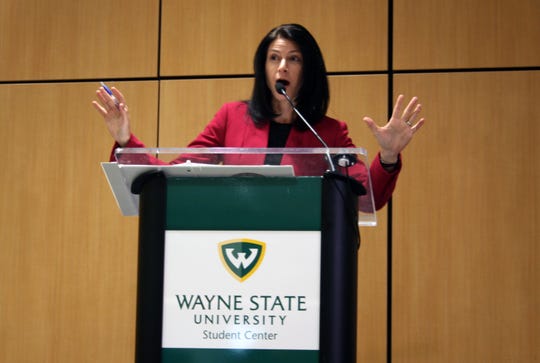
Attorney General Dana Nessel speaks to members of the public and the media at FOIA Fest, an event about the Freedom of Information Act, hosted by the Society for Professional Journalists at Wayne State University on Saturday.Detroit — Michigan Attorney General Dana Nessel told a room of journalists and members of the public that she is "deeply ashamed" that Michigan is the only state that exempts the governor, lieutenant governor and state lawmakers from Freedom of Information Act requests.

"We are not opening the doors to state government," Nessel said Saturday. "In fact, we are locking them with deadbolts, and then we are nailing boards across them, and then there’s a moat … that’s what FOIA feels like with our state government."

Attorney General Dana Nessel speaks to members of the public and the media at FOIA Fest, an event about the Freedom of Information Act, hosted by the Society for Professional Journalists at Wayne State University on Saturday.Buy Photo
Attorney General Dana Nessel speaks to members of the public and the media at FOIA Fest, an event about the Freedom of Information Act, hosted by the Society for Professional Journalists at Wayne State University on Saturday. (Photo: Kevin J Hardy / The Detroit News)

Nessel was the keynote speaker at a day-long festival focused on how to reform FOIA exclusions to the executive and legislative branches of government, developing a state ombudsman or independent commission for FOIA appeals, and reform excessive fees, delays and loopholes in the state's system.

Nessel, who took office in January, has called for more government transparency while noting Michigan's current FOIA restrictions.

"I can’t think of anything more important than to have the public have all the tools available to them and know how to get information," she said.

Kat Stafford, a reporter for the Detroit Free Press, introduced Nessel, saying the attorney general was invited to the FOIA Festival, hosted at Wayne State University by the Society of Professional Journalists, because she's been advocating the importance of government transparency for Michigan residents.

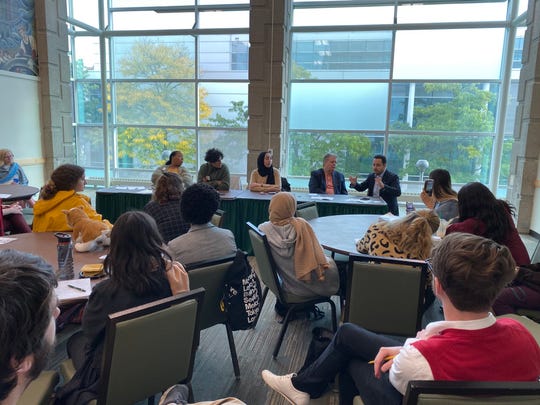
Current and former members of the The South End student newspaper at Wayne State University, which is funded by the university but is editorially independent, share difficulties of filing FOIA requests within their own campus and how they studied student press law after being restricted.Current and former members of the The South End student newspaper at Wayne State University, which is funded by the university but is editorially independent, share difficulties of filing FOIA requests within their own campus and how they studied student press law after being restricted.

Nessel also used the event to take a few shots at the Trump administration, saying the lack of transparency in Michigan is nothing compared to what is going on at the federal level.

"While I am embarrassed on various levels for our lack of transparency in Michigan, but what’s happening in the federal government right now is absolutely unacceptable," Nessel said. "Without these constructs in place, it will be the end of America as we know it."

Nessel also addressed the investigation of John Geddert, a former USA Gymnastics coach who oversaw a Michigan club where multiple victims of sexual predator Larry Nassar trained, Nessel said her office continues to try to get documents Michigan State University has withheld under attorney-client privilege.

MSU initially withheld 7,500 documents under attorney-client privilege and it appears as though her office is not going to see 6,000 of those documents because the university has "fought this office every step of the way."

She called it disingenuous that MSU would ask for the attorney general's office to investigate and then refuse to provide the evidence they need.

"We’ve taken this as far as we can. To fully complete our investigation, we absolutely need to have those emails," she said. "I would ask the board of trustees to reconsider and provide us with those 6,000 plus emails so we can actually complete our investigation."

Beth Konrad, president of the SPJ Detroit chapter and adjunct professor at WSU, said the idea for Saturday's FOIA festival was aimed to build greater awareness and understanding of FOIA and Michigan's Open Meeting Act for better government transparency.

Voting is beautiful, be beautiful ~ vote.©

Sunday, February 16, 2020

Did Rochelle Riley Become The Burden For Wayne State University Press?

I wonder if it has anything to do with that crap Rochelle Riley published about my Sweetie.

Meet Detroit Paid Segregationist Rochelle Riley - Co-Conspirator Meanie Who Bleachbits The Legacy Of Conyers

That University Press has a history of publishing crap, then making the students pay ridiculous amounts of money for the textbooks. 

Particularly child welfare crap, but hey, what do I know?

I know there are individuals associated with this institution who just so happen to hate my guts as I am such "The Burden".

Hey, Rochelle, have a great day!


via GIPHY

Wayne State president weighs in on university press overhaul

Dr. M. Roy Wilson, President of Wayne St. University, answers a question.
Roy Wilson
Detroit — After a shakeup at Wayne State University Press last week, President M. Roy Wilson intervened Friday to detour speculation, saying the school has no intention of dismantling or discontinuing its work.

A week ago, three managers of the University Press were terminated including the press's editor-in-chief. The decision was "reached only after careful and deep consideration at every level," according to a statement to the faculty editorial board, which was obtained by The News.

Wayne State Press is located in the center of campus at, 4809 Woodward Ave, Detroit.

The decision faced backlash online and 60 writers, reviewers and scholars signed an open letter insisting that the University Press immediately reinstate the three managers: editor-in-chief Annie Martin; Kristin Harpster, a design and production manager; and sales and marketing director Emily Nowak.

The letter stated it "is a breach of trust with the authors who have built relationships and served as ambassadors of the press in the academic and wider community ... moreover, these decisions will undermine the ability of Wayne State Press to recruit and serve scholars and writers at all stages of the publication process."

Wilson reviewed the actions taken by the University Press "and while it is inappropriate to discuss personnel matters publicly, I understand the rationale behind them," he said.

In a letter to colleagues, he said the university intends to support the University Press' mission and have already begun the search process to fill the positions quickly. In the meantime, Tara Reeser will continue as interim director of the WSU Press.

The University Press has been a leading publisher of Great Lakes books, Judaica, and African American studies since 1941. The Press, which is located in the center of campus on Woodward Avenue, publishes approximately 40 new books and 11 journals per year.

"Additionally, to ensure we meet our contractual obligations, we are exploring outside contractual services to provide support as necessary," he said.

Wilson ordered the University Press to begin reporting to his office through his chief of staff, Michael Wright, who also leads WDET and is vice president of marketing and communications for the university.

"As I mentioned in response to concerns expressed earlier this week, the mission of the WSU Press — 'generating high-quality scholarly and general interest works of global importance' — remains intact. And the work of the press — especially the timeless art of publishing scholarly, necessary and interesting books — continues. I appreciate your work and support during this time of transition."

Voting is beautiful, be beautiful ~ vote.©

Wednesday, March 26, 2014

Conyers Announces $752,000 in Grant Awards to Wayne State & the Detroit Institute of Arts


(WASHINGTON) – Today, Congressman John Conyers, Jr. (D-Mich.) announced $752,000 in funding - split between five individual grants - from the Department of Health and Human Services (HHS) and the National Endowment for the Humanities (NEH) for Wayne State University and the Detroit Institute of Arts. Specifically, the National Eye Institute within HHS awarded $380,000 to Wayne State University to research the role of the protein HMGB1 in bacterial keratitis. Wayne State University was also awarded: $60,000 in NEH Digital Humanities Start-Up Grant funding for a project entitled “Ethnic Layers of Detroit: Experiencing Place through Digital Storytelling; $6,000 in NEH summer stipend funding for a “Theoretical and Historical Account of Media Viewership” project; and $6,000 in NEH summer stipend funding for a project on, “Black Women’s Disenfranchisement and the Fight for Voting Rights, 1920-1945.” In addition, NEH awarded the Detroit Institute of Arts a $300,000 grant through their Museums, Libraries, and Cultural Organizations Implementation office to put on an exhibit entitled the, “Art of American Dance.”

After the grant recipients were made public, Rep. Conyers issued the following statement:

U.S. Representative
John Conyers, Jr.
“I am pleased to announce that the Department of Health and Human Services (HHS) and the National Endowment for the Humanities (NEH) have awarded a combined $752,000 in grant funding to Wayne State University and the Detroit Institute of Arts for five deserving projects that will improve public health and showcase Detroit’s rich history,” said Conyers.

“A $380,000 vision research grant awarded to Wayne State by the HHS National Eye Institute will aid medical researchers studying the role of a protein in bacterial keratitis. This funding will go a long way towards understanding the complexities of keratitis, a serious infection in the cornea that can lead to severe vision loss.

“Wayne State was also the recipient of three grant awards to further enrich the University’s humanities offerings. These awards included: a $60,000 Digital Humanities Start-Up grant to fund a historical project entitled, ‘Ethnic Layers of Detroit: Experiencing Place through Digital Storytelling”; a $6,000 summer stipend for work on a ‘Theoretical and Historical Account of Media Viewership’ project; and a $6,000 summer stipend for project studying, ‘Black Women’s Disenfranchisement and the Fight for Voting Rights, 1920-1945.’ Additionally, the Detroit Institute of Arts was awarded $300,000 to organize an ‘Art of American Dance’ exhibit for the community.

“I applaud HHS for their commitment to combating troublesome public health concerns, and I commend the NEH for helping to further enhance the Detroit metropolitan area’s creative culture.”

Voting is beautiful, be beautiful ~ vote.©